
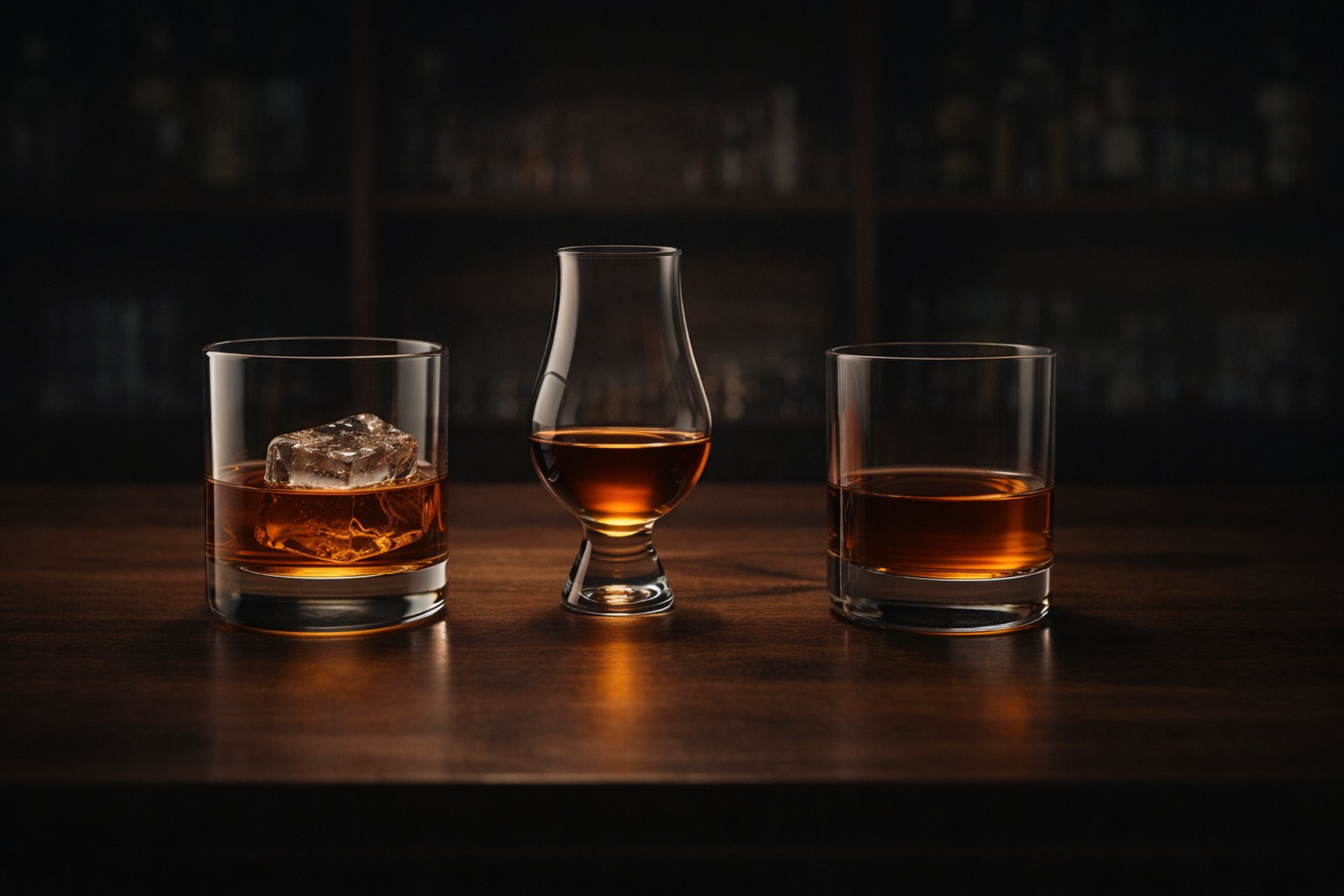
Best Whiskey Glasses
Glassware influences perception.
A wide rim disperses aroma.
A narrow rim concentrates it.
Base thickness affects temperature stability.
Weight influences balance in hand.
The correct glass does not change the spirit — it changes how you experience it.
This guide evaluates construction quality, rim design, weight, durability, and versatility.
No novelty shapes.
No fragile decorative crystal.
Only functional architecture.
BEST Essential
Essential Whiskey Glass
Best for: Most Home Bars
$$
BEST Refined
Refined Whiskey Glass
Best for: Frequent Use
$$ - $$$
BEST PREMIUM
Pro Whiskey Glass
Best for: Long-Term Build
$$$
Transparency Note: We may earn a commission from qualifying purchases. Product selections are made independently and are not influenced by manufacturers.
Types of Whiskey Glasses
Before selecting a model, understand structure.
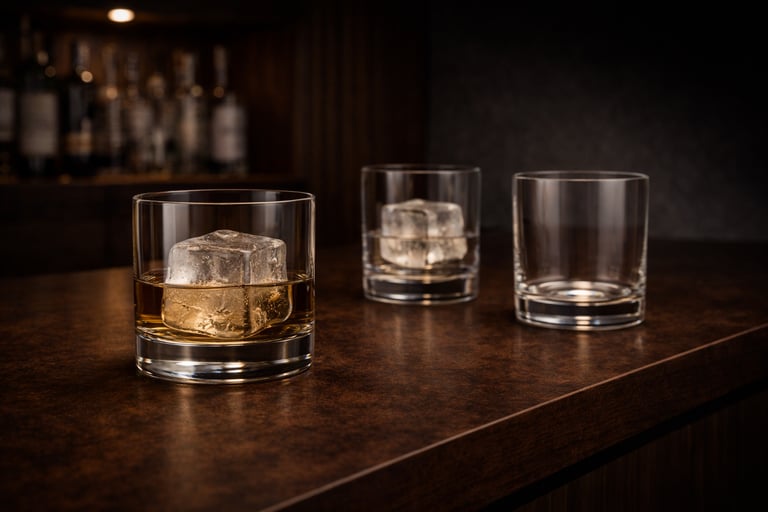
Rocks Glass (Old Fashioned Glass)
Wide opening, thick base.
Best for:
Whiskey on the rocks
Large-format ice
Spirit-forward cocktails
Strengths:
Stability
Versatility
Durability
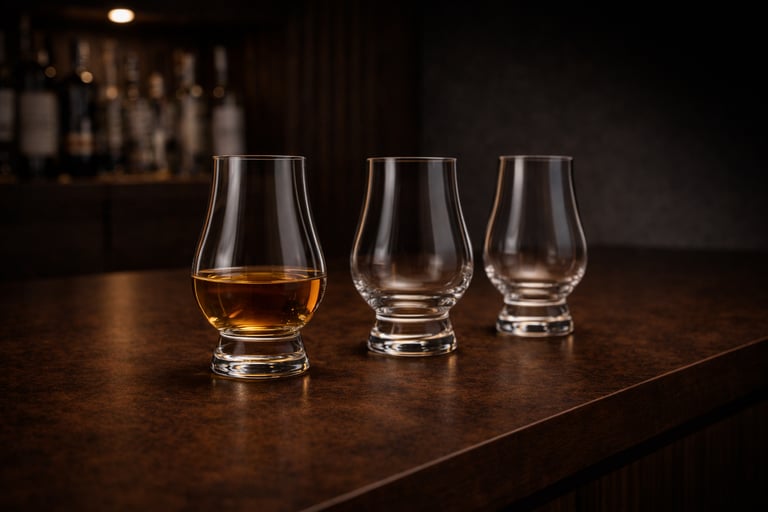
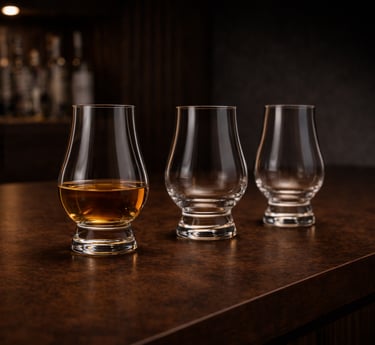
Glencairn-Style Tasting Glass
Tulip shape with narrow rim.
Best for:
Neat pours
Aroma concentration
Focused tasting
Strengths:
Enhances nose
Designed for evaluation
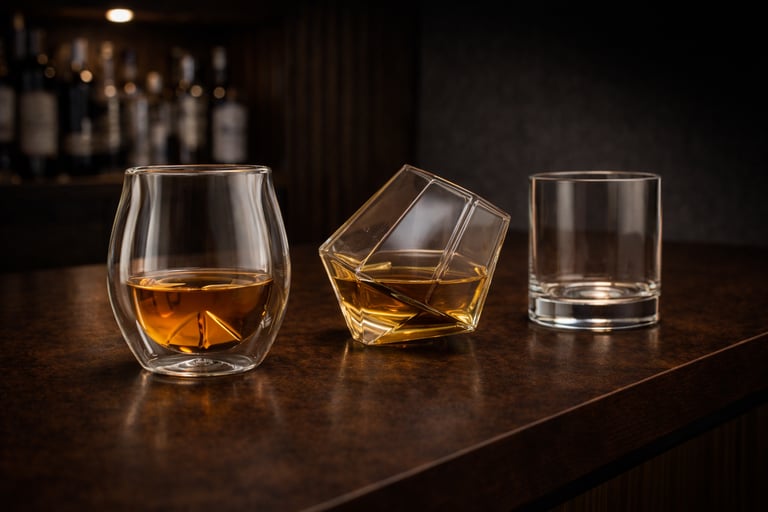
Modern Tumbler Variants
Minimalist, weighted, sometimes thinner rim.
Best for:
Contemporary setups
Multi-use applications
Strengths:
Design-forward
Comfortable grip
What to Look For
When evaluating whiskey glasses, prioritize:
Balanced weight
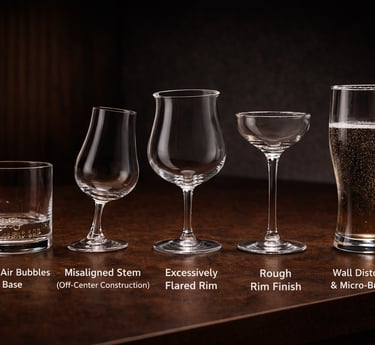
Smooth rim finish
Stable base thickness
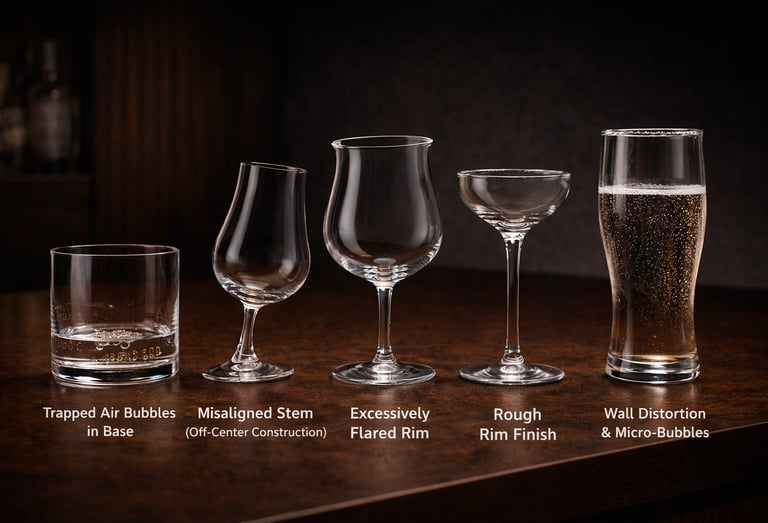
Clarity (no bubbles or distortion)
Dishwasher-safe durability
Avoid:
Excessively thin bases
Decorative etching that distracts
Extremely flared rims
A well-built glass should feel intentional in hand.
Material Considerations
Crystal
Higher clarity
Finer rim
More delicate
Standard Glass
More durable
Dishwasher-friendly
Slightly thicker feel
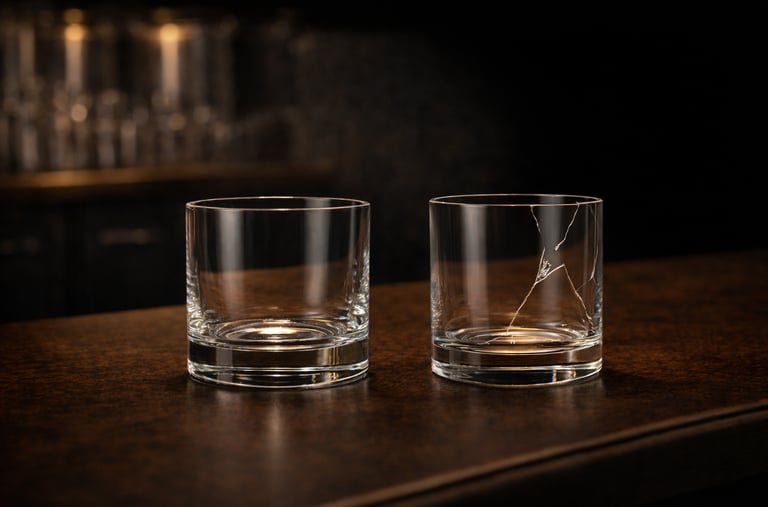
For daily use, durability often outweighs refinement.
Rocks vs Tasting Glass —
Which Should You Choose?
If you primarily drink:
Neat pours for evaluation → Tulip style
Whiskey with ice → Rocks glass
Cocktails like Old Fashioneds → Rocks glass
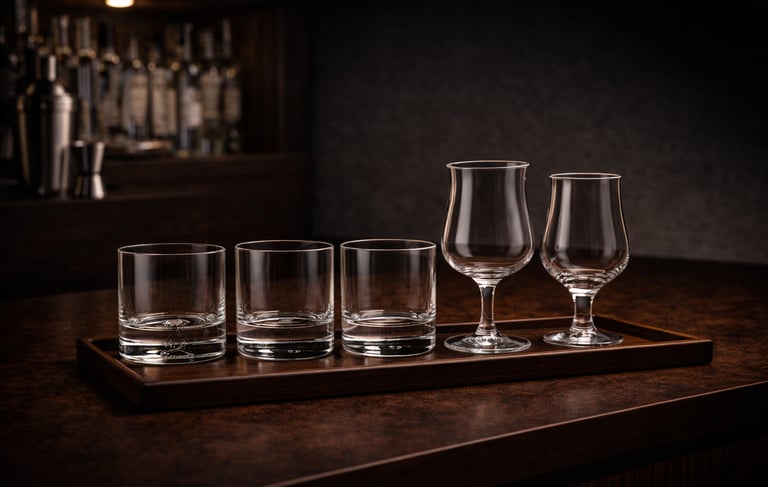
Many well-built home bars operate effectively with:
4 quality rocks glasses
2 tasting glasses
Beyond that, expansion becomes preference-driven.
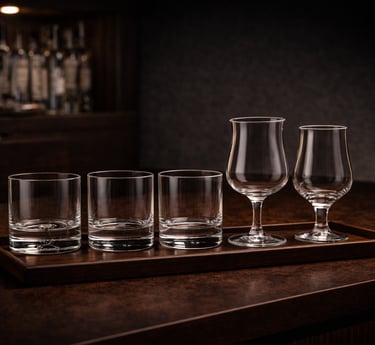
Choosing the Right Whiskey Glass
Essential · Standard Tumbler
The Essential tier prioritizes durability and balanced aromatic exposure.
These glasses provide stable base weight and moderate bowl width, suitable for neat pours or whiskey served with ice.
Wide bowl design
Stable, weighted base
Standard rim cut
Everyday durability
Designed for daily use and general whiskey service.
Best suited for casual pours and foundational home bars.
Refined · Tapered Whiskey Glass
The Refined tier improves aromatic concentration and rim precision.
An inward taper reduces ethanol dispersion while enhancing nose clarity during tasting.
Moderate inward taper
Thinner, laser-cut rim
Balanced weight distribution
Improved hand control
Built for focused tasting and structured whiskey evaluation.
Recommended for spirit-forward study and intentional service.
Professional · Service Tasting Glass
The Professional tier emphasizes engineered taper and long-term durability.
Precise bowl geometry and refined rim cut support advanced tasting programs and sustained service environments.
Engineered inward taper
Ultra-thin precision rim
Optimized center of gravity
Commercial-grade durability
Designed for advanced whiskey programs and disciplined tasting environments.
Built for maximum aromatic concentration and structural consistency.
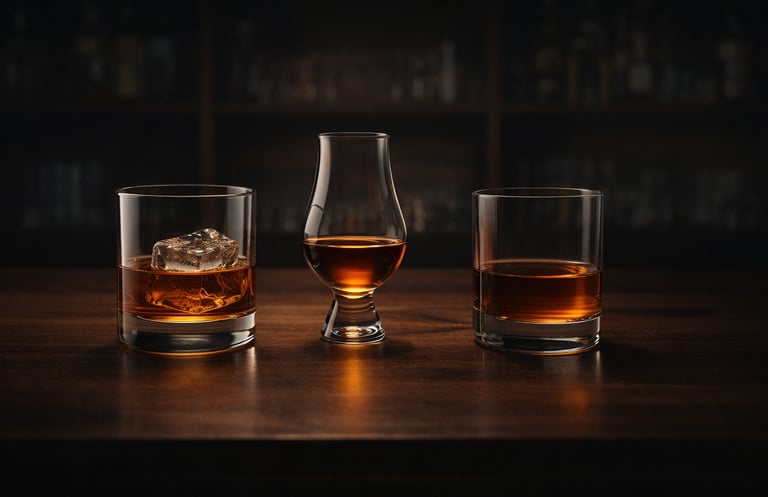
The following selections represent the strongest structural examples within each tier.
Bowl width influences ethanol dispersion. Inward taper concentrates aromatics. Base weight stabilizes the pour. Rim precision affects delivery.
Performance is defined by structure — not thickness or decorative cut.
Below is a breakdown of the tiers that matter most.
Essential Whiskey
Glass
BEST FOR: DAILY NEAT POURS
Built for balanced bowl width, stable base weight, and controlled aromatic exposure during everyday whiskey service.
TYPE
Standard Tumbler
RIM PROFILE
Standard Cut
PROPORTION
Wide / Balanced
DURABILITY
Reinforced Glass
WHY IT WINS Essential
Stable hand feel
Balanced aromatic release
Durable for daily pours
USE CASE
Neat whiskey
Whiskey with ice
Everyday pours
8.9
OVERALL SCORE
Refined Whiskey
Glass
BEST FOR: STRUCTURED TASTING
Built for inward taper control, improved aromatic concentration, and cleaner rim delivery during focused pours.
TYPE
Tapered Whiskey
RIM PROFILE
Laser-Cut Thin
PROPORTION
Moderate Taper
DURABILITY
Refined Strength
WHY IT WINS Refined
Enhanced aroma concentration
Cleaner sip flow
Improved hand balance
USE CASE
Focused tastings
Spirit-forward evaluation
Controlled dilution with ice
9.2
OVERALL SCORE
Pro/Service
Whiskey Glass
BEST FOR: SERVICE & TASTING ENVIRONMENTS
Built for engineered bowl taper, rim finesse, and structural durability under sustained whiskey service.
TYPE
Service Tasting
RIM PROFILE
Ultra-Thin Laser Cut
PROPORTION
Engineered Taper
DURABILITY
Commercial Strength
WHY IT WINS Pro
Optimized aromatic release
Balanced stem geometry
Built for repetition
USE CASE
Whiskey tasting programs
High-volume service
Advanced spirit evaluation
9.5
OVERALL SCORE
How We Evaluate Whiskey Glasses
1. Bowl Geometry & Inward Taper
Bowl width determines surface exposure. Inward taper concentrates aroma.
Wide tumblers allow ethanol to disperse more freely. Tapered bowls focus aromatics toward the nose while reducing harsh alcohol lift.
We assess:
Maximum bowl diameter
Degree of inward taper
Depth-to-width ratio
Surface exposure balance
Geometry must support aromatic clarity without over-concentrating ethanol.
2. Rim Thickness & Delivery Control
Rim profile affects sip flow and tactile perception.
Thin, laser-cut rims allow smoother delivery and more controlled palate entry. Thick rolled rims can interrupt flow and reduce perceived refinement.
We assess:
Rim thickness consistency
Edge precision
Uniformity around circumference
Long-term chip resistance
Delivery precision influences tasting accuracy.
3. Base Weight & Stability
Whiskey glasses are frequently held and swirled.
Base weight stabilizes the pour and improves grip control during nosing and evaluation.
We assess:
Base thickness
Weight distribution
Center-of-gravity balance
Stability on flat surfaces
Balance improves both handling and perception control.
4. Swirl Dynamics & Ice Interaction
Whiskey glasses must accommodate both neat pours and optional ice.
We evaluate:
Internal clearance for swirl motion
Compatibility with large-format ice
Dilution pacing with single cubes
Vertical clearance relative to taper
Structure must support controlled agitation without splash.
5. Material Durability & Clarity
Whiskey glasses are used repeatedly and often washed frequently.
We assess:
Optical clarity
Resistance to rim chipping
Structural strength under temperature variation
Performance through repeated wash cycles
Durability must coexist with aromatic precision.
What We Do Not Consider
Decorative cut patterns
Excessive wall thickness as a sign of “luxury”
Brand prestige
Color tinting
Packaging presentation
A whiskey glass is evaluated on how its structure shapes aroma, controls ethanol lift, and supports stable handling — not on how heavy or ornate it appears.
Structure determines quality.
A whiskey glass is designed to shape aroma, control ethanol dispersion, and stabilize temperature during neat or lightly diluted pours.
Its structure influences how aromatics concentrate, how alcohol lifts toward the nose, and how the spirit moves across the palate. We evaluate whiskey glasses based on bowl geometry, inward taper, rim precision, weight distribution, and durability under repeated use — not decorative thickness or brand prestige.
Whiskey Glass Frequently Asked Questions
1. Does glass shape affect how whiskey smells?
Yes.
Bowl width and inward taper determine how aromatics concentrate and how ethanol lifts toward the nose.
Tapered glasses focus aroma. Wide tumblers allow greater dispersion.
2. Is a Glencairn-style glass better than a tumbler?
For focused tasting, often yes.
Tapered glasses concentrate aroma and reduce ethanol harshness. Tumblers prioritize stability and versatility, especially with ice.
Use case determines structure.
3. Does heavier glass improve performance?
Not necessarily.
Excessive weight does not enhance aroma or flavor. Base stability matters, but wall thickness and mass alone do not improve perception.
Weight is not a quality indicator.
4. Why do tasting glasses taper inward?
Inward taper concentrates aromatic compounds and moderates ethanol lift.
This improves clarity during nosing without increasing surface exposure excessively.
Taper is functional, not decorative.
5. Are wide tumblers bad for neat whiskey?
No.
They provide balanced exposure and comfortable handling. However, they do not concentrate aroma as effectively as tapered tasting glasses.
They serve a different purpose.
6. Does rim thickness matter for whiskey?
Yes.
Thin, precision-cut rims allow smoother palate entry and improved tactile refinement.
Thick rolled rims can slightly disrupt delivery.
7. Does ice change which glass is best?
Yes.
Large-format ice performs better in wider bowls that allow vertical clearance and controlled dilution.
Tapered glasses are better suited for neat pours or minimal dilution.
8. Is crystal necessary for proper whiskey tasting?
Not inherently.
Crystal may allow thinner construction and improved clarity, but bowl geometry and rim precision influence performance more than material label alone.
9. Why do some glasses amplify ethanol burn?
Excessively narrow openings or poor taper ratios can concentrate ethanol too aggressively.
Balanced taper moderates alcohol lift while preserving aromatic complexity.
10. How long should a quality whiskey glass last?
A well-constructed glass should maintain rim integrity, clarity, and structural balance through repeated use and washing.
Durability must support regular handling without compromising geometry.
Building Intelligently
You do not need a cabinet of specialty shapes.
You need:
A stable rocks glass
A focused tasting glass
Proper ice
Paired with:
→ Best Ice Molds
→ Ice & Temperature Control
→ Essential Tools for a Home Bar
Glassware should enhance structure — not distract from it.
© 2026 Barkeepers Buzz. All rights reserved.
Barkeepers Buzz
Master cocktails, spirits, and bar knowledge with clarity and precision. Built for serious home enthusiasts.
Crafted with respect for the culture — and the responsibility that comes with it.
For educational purposes only. Intended for legal drinking age audiences. Please drink responsibly.
General Inquiries: