
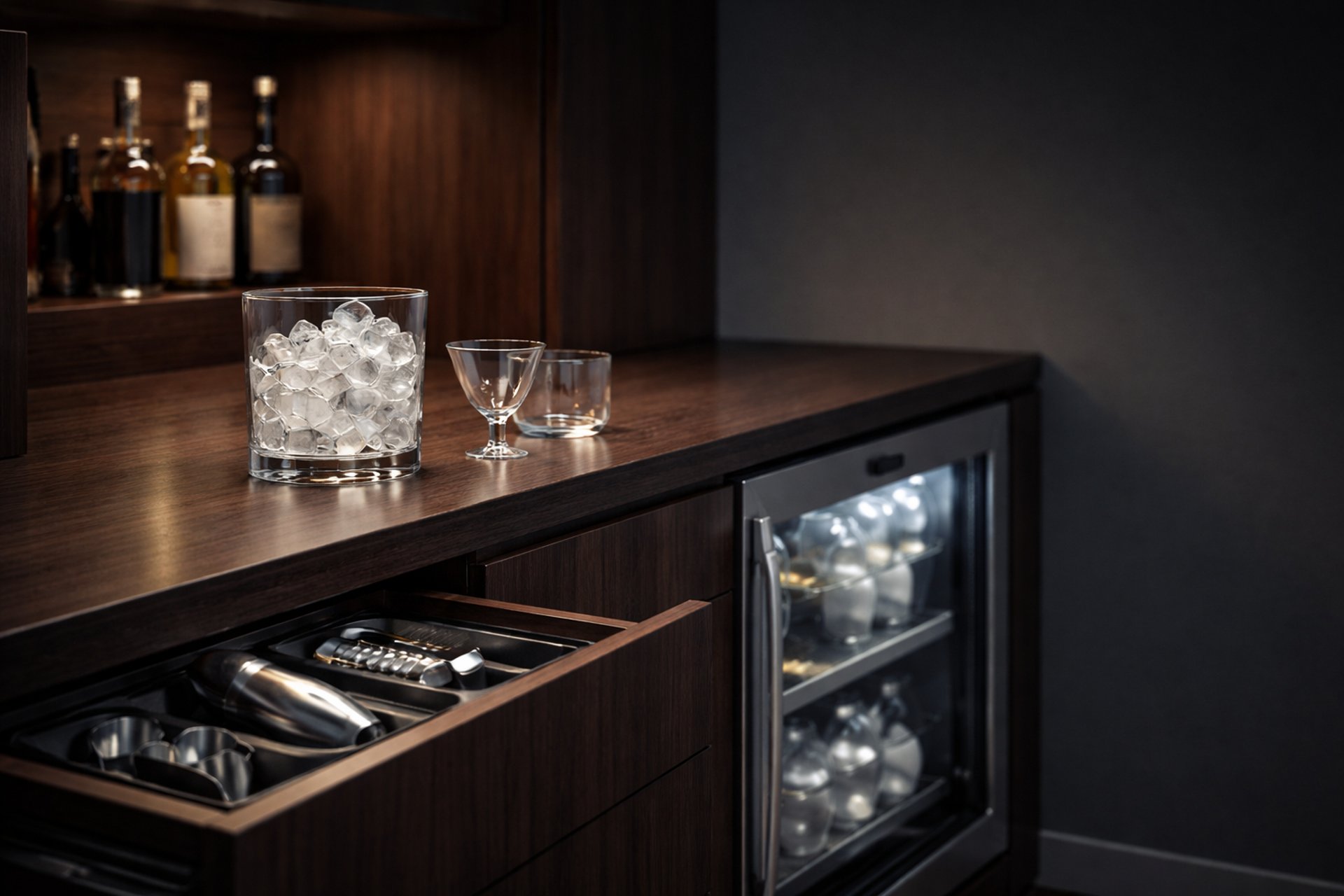
Best Wine Fridges for Home Bars
Controlled Storage. Structured Temperature. Long-Term Preservation.
A serious home bar is built on control.
Control of dilution.
Control of storage.
Control of temperature.
Wine is one of the most temperature-sensitive components in a home bar system. Improper storage degrades aroma, texture, acidity balance, and long-term stability.
If your home bar includes:
Red and white wine service
Champagne or sparkling storage
Wine-based cocktails
Regular entertaining
Long-term bottle rotation
Then a dedicated wine fridge becomes infrastructure — not luxury.
This guide breaks down the best wine fridge types for home bars, how they differ, and how to choose the right system based on structure, space, and service intent.
Transparency Note: We may earn a commission from qualifying purchases. Product selections are made independently and are not influenced by manufacturers.
Why a Wine Fridge Is Different From a Kitchen Refrigerator
A standard refrigerator is built for food safety.
It:
Cycles aggressively
Maintains lower humidity
Runs colder than ideal for wine
Experiences frequent door openings
Produces more vibration
Wine requires stability — not extreme cold.
Ideal wine storage conditions include:
45°F–65°F controlled temperature range
Minimal temperature fluctuation
50–70% relative humidity
Low vibration
UV protection
Kitchen refrigerators fluctuate too aggressively for long-term wine integrity.
If structure determines quality, separation determines control.
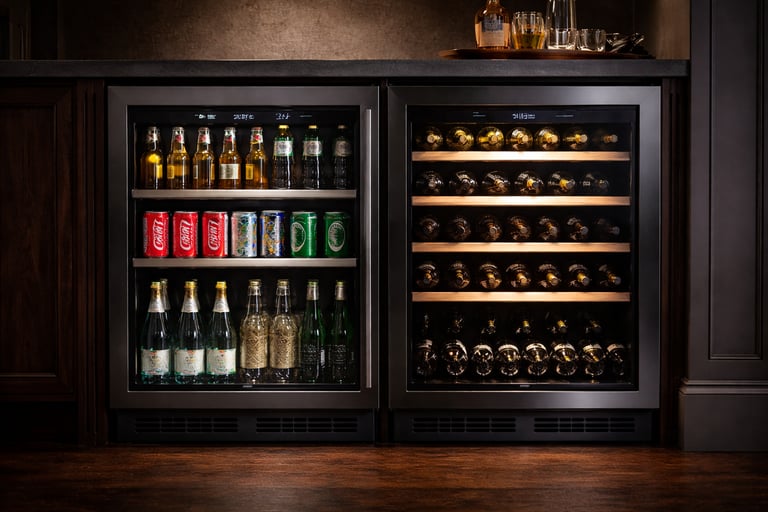
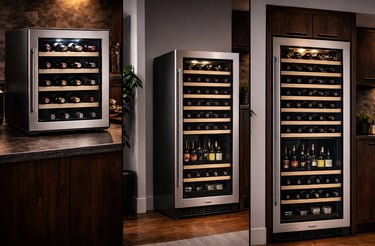
The Three Core Wine Fridge Types
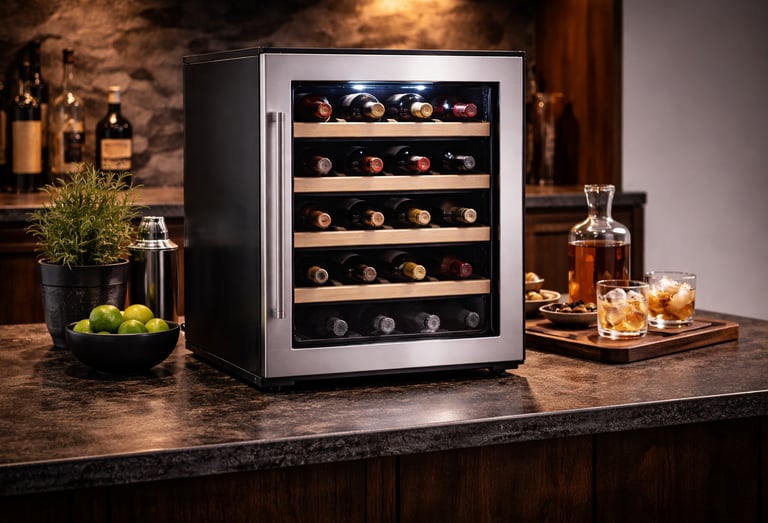
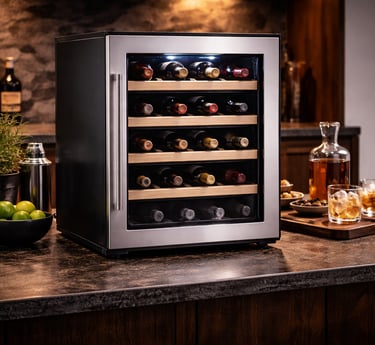
Flexible Placement & Entry Access
Freestanding units require rear ventilation and cannot be installed flush inside cabinetry unless specifically designed for it.
Best For:
Apartment setups
Bar corners
Small to mid-size collections
Flexible placement
Advantages:
Lower cost entry point
Wide sizing options
Simple installation
Limitations:
Requires clearance behind unit
Not ideal for permanent built-in installations
Freestanding models represent the Essential tier for many home bar builds.
Built-In / Under-Counter Wine Fridges
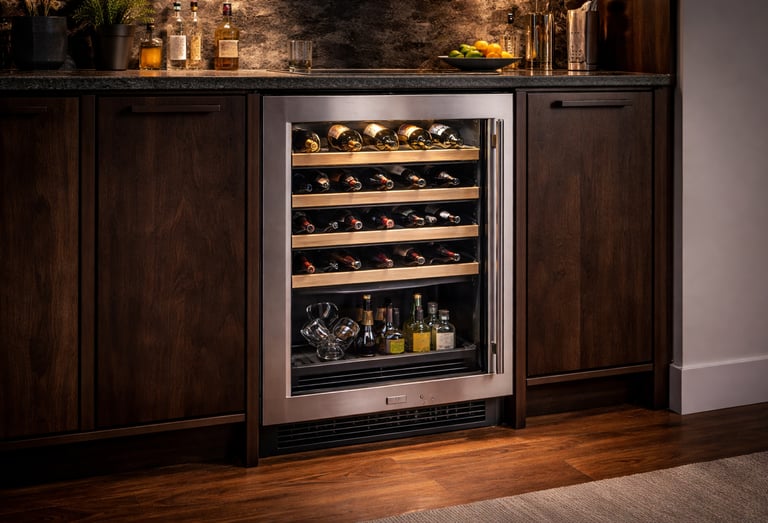
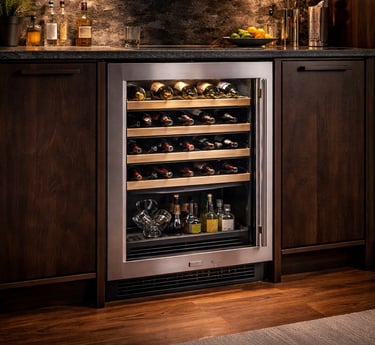
Integrated Architectural Installation
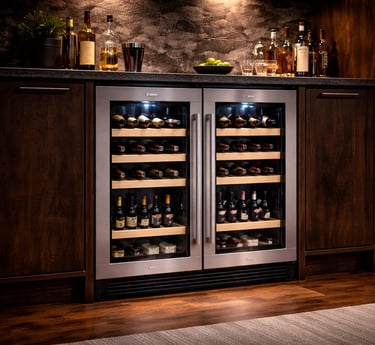
Built-in units vent from the front, allowing flush cabinet installation.
Best For:
Permanent bar builds
Renovations
Basement lounge installs
High-end integrated designs
Advantages:
Seamless cabinetry finish
Clean aesthetic
Structured long-term solution
Limitations:
Higher price point
Requires measurement discipline
Built-in units represent installation commitment — not temporary storage.
Dual-Zone Wine Fridges
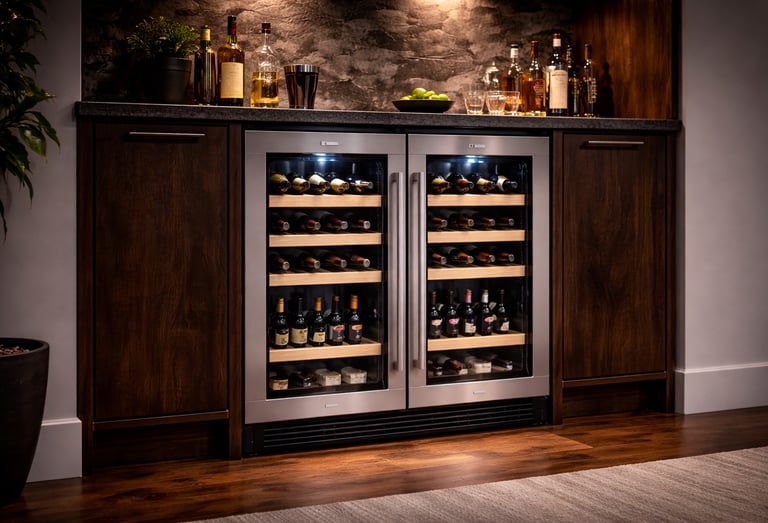
Structured Temperature Separation
Dual-zone units allow independent temperature control in two compartments.
Best For:
Mixed wine collections
Regular hosting
Balanced red/white storage
Advantages:
Separate service temperatures
Flexible entertaining
Better bottle rotation
Single-zone units are ideal for uniform collections. Dual-zone units increase flexibility.
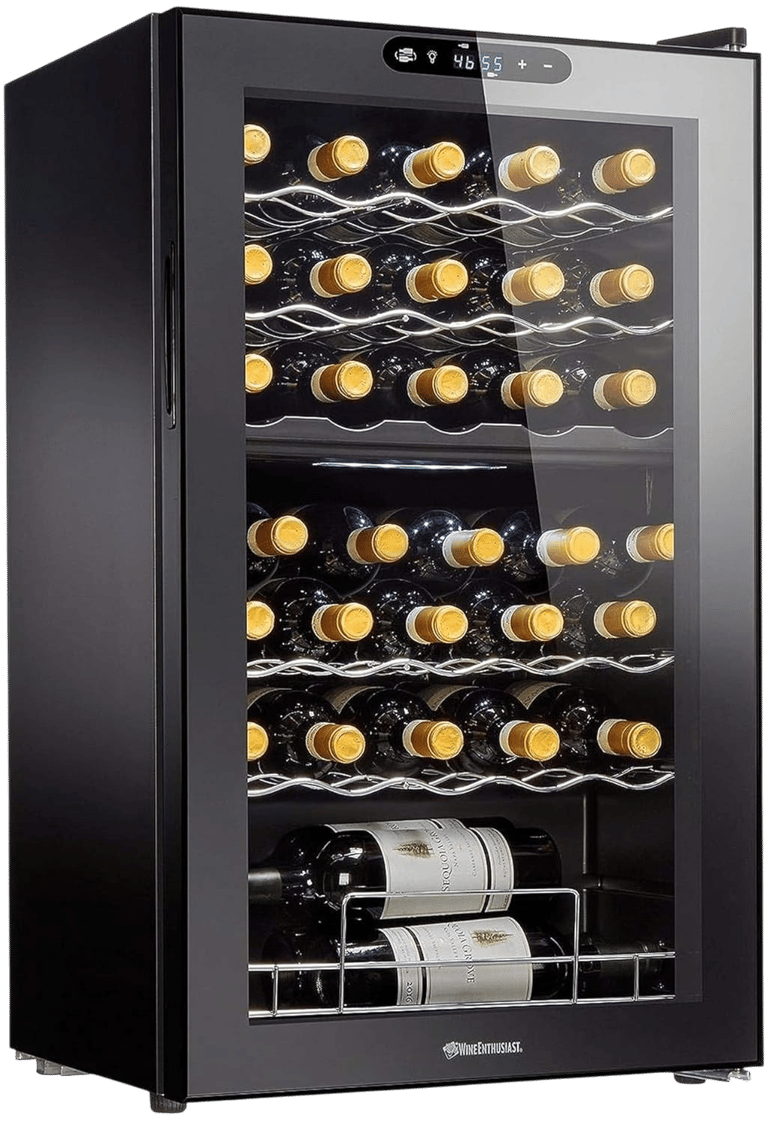
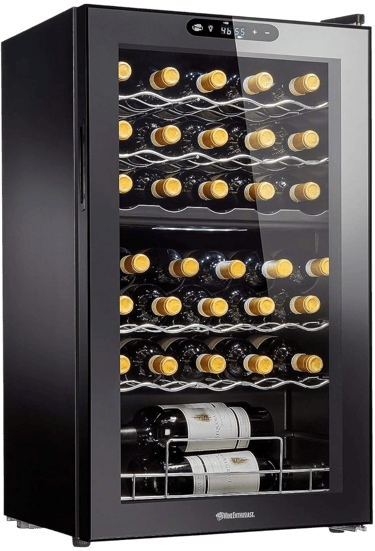
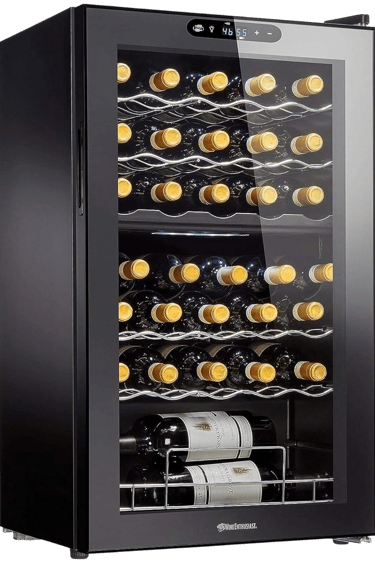
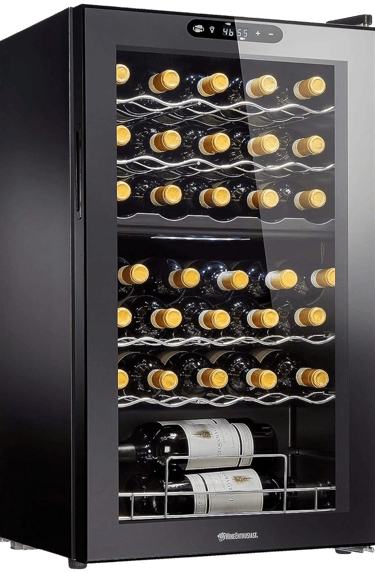
Wine Enthusiast 32-Bottle Dual Zone MAX
When most wine fridges try to maximize bottle count, they usually sacrifice either shelf usability or real-world placement. The Wine Enthusiast 32-Bottle Dual Zone MAX lands in a much more balanced position.
The footprint is compact enough for kitchens and home bars, but the dual-zone layout still gives enough flexibility to properly separate serving wines from longer-term storage.
What makes this fridge work especially well is usability. The compressor cooling system performs far more consistently than older thermoelectric systems, while the digital controls and split-zone layout make temperature management much easier during everyday use.
This is also one of the safer choices for mixed home bar setups where the collection includes:
reds
whites
sparkling bottles
entertaining rotation bottles
Where it performs best is overall balance. It feels large enough to matter without becoming oversized furniture.
Specs (Quick Breakdown)
Capacity: 32 Bordeaux bottles
Cooling Zones: Dual-zone
Temperature Range: 41°F–64°F
Cooling System: MAX compressor cooling
Dimensions: 17” D × 19.5” W × 33.5” H
Shelves: Chrome wire shelves
Door: Dual-pane mirrored glass
Controls: Electronic touchscreen + blue LED display
Installation: Freestanding
Weight: Approx. 60 lbs net weight
Warranty: 1-year parts/labor + 3-year sealed system
Why This Wins
The Wine Enthusiast avoids the two biggest problems many wine fridges have:
too small to grow into
too large for realistic home placement
It lands directly in the middle.
The dual-zone flexibility, quieter compressor operation, and approachable footprint make it one of the safest all-around wine fridge choices for home bars.
👉 If you want the best overall balance of capacity, cooling, and real-world usability, this is the safest overall pick.
BUZZ'S TOP PICK
Wine Enthusiast Dual Zone MAX
Best Overall
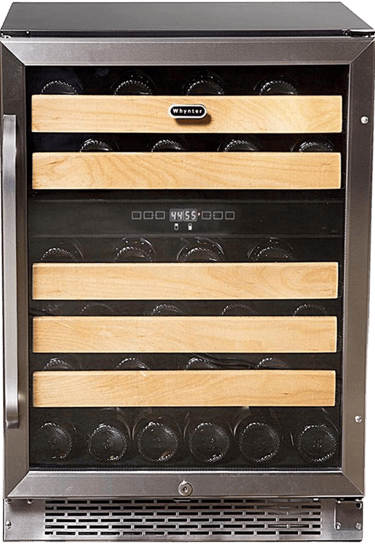
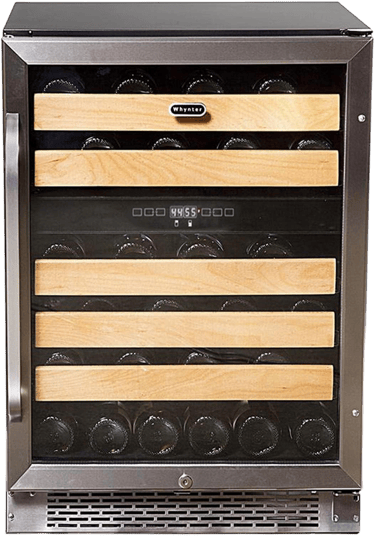
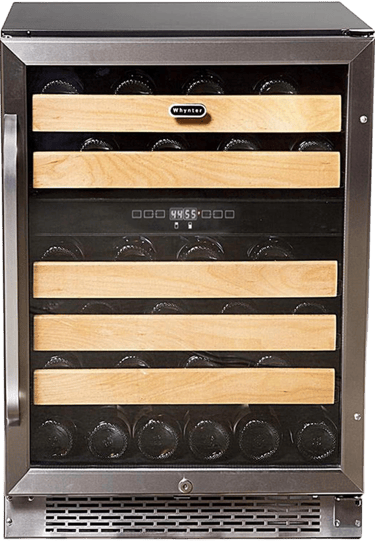
Whynter 46-Bottle Dual Temperature Zone
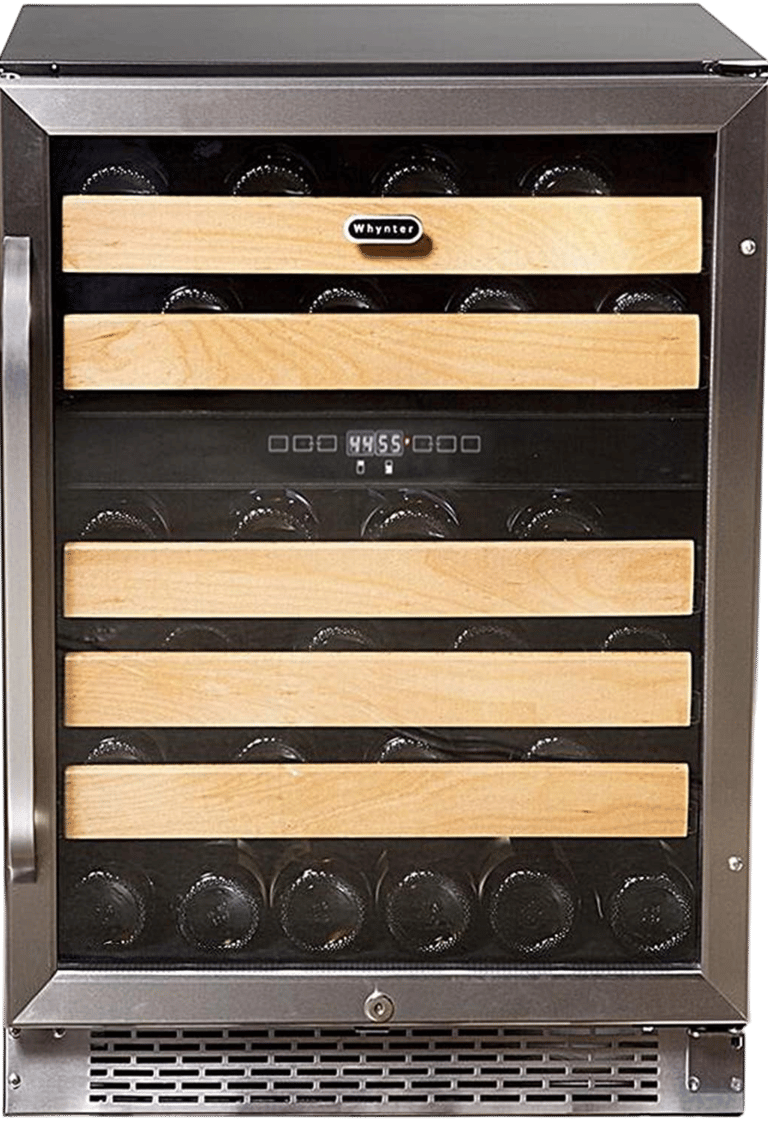
The Whynter 46-Bottle shifts more heavily toward enthusiast-level storage and cooling performance.
This fridge feels noticeably more serious than compact starter wine coolers. The larger bottle capacity, dual independent temperature zones, and compressor cooling system make it much better suited for expanding collections and heavier entertaining use.
One of the strongest features here is the actual layout efficiency. The split between the upper and lower temperature zones gives significantly more flexibility for mixed wine storage.
The built-in capable design also makes this fridge much easier to integrate into:
custom bars
cabinetry
modern kitchens
undercounter layouts
Where this fridge performs best is long-term reliability and collection growth.
Specs (Quick Breakdown)
Capacity: 46 standard 750ml bottles
Cooling Zones: Dual-zone independent cooling
Upper Zone: 41°F–50°F
Lower Zone: 50°F–72°F
Cooling System: Compressor cooling
Installation: Built-in or freestanding
Door: Stainless trimmed glass door
Shelves: 5 detachable wood-faced slide-out shelves
Security: Lock + key included
Power: 100 watts / 1.0 amp
Dimensions: Approx. 32.5” H × 23.5” W × 22.5” D
Why This Wins
The Whynter feels much closer to enthusiast-grade cooling than entry-level wine refrigerators.
It combines stronger compressor performance, larger bottle storage, and built-in flexibility without immediately jumping into luxury collector pricing.
👉 If you want a more serious wine storage setup for entertaining or growing collections, this is one of the strongest midrange options available.
BUZZ'S TOP PICK
Whynter Dual Temperature Zone
Best Enthusiast Storage
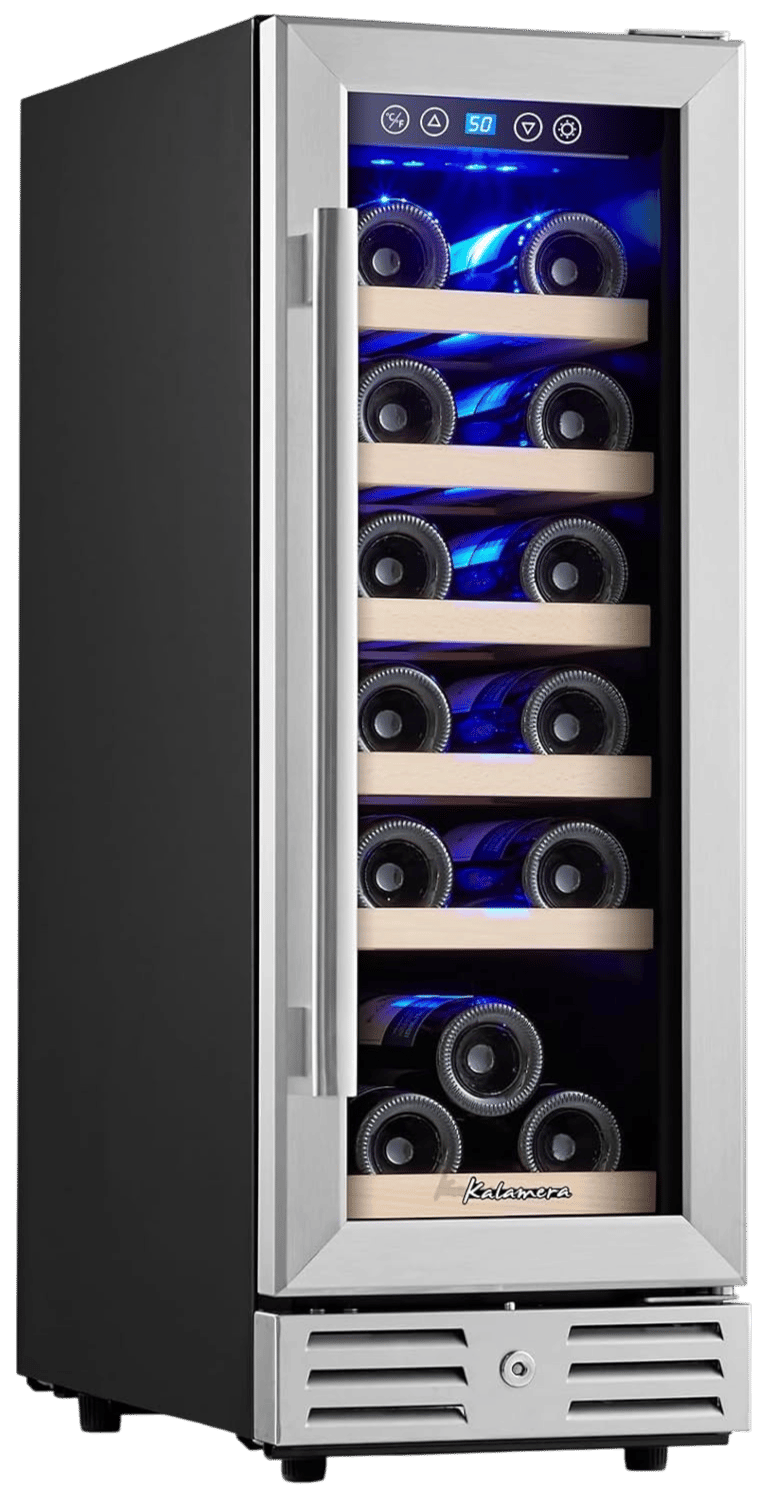
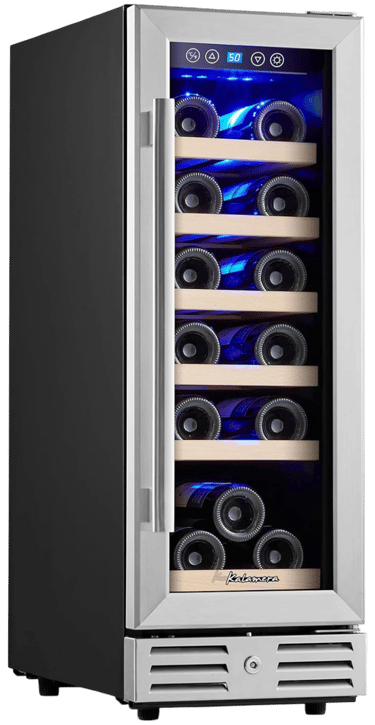
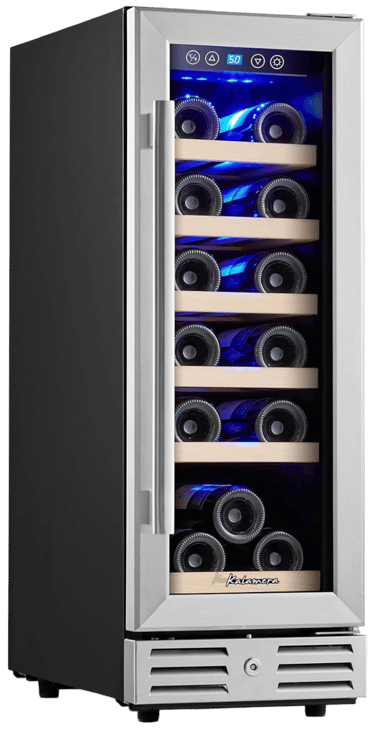
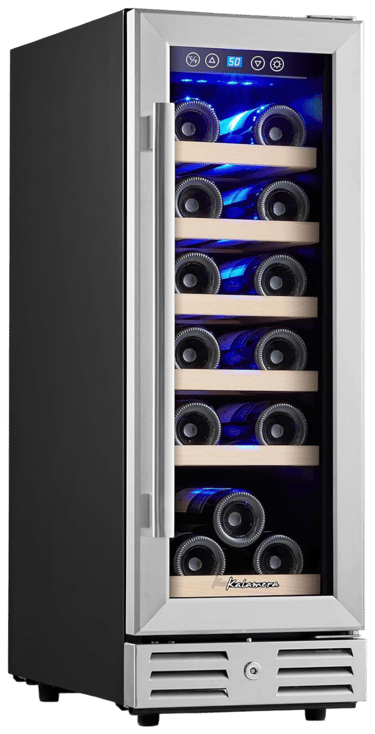
Kalamera Mini Fridge 18 Bottle — 12 Inch
The Kalamera 12-inch wine fridge focuses almost entirely on efficient integration.
Unlike larger freestanding systems, this fridge is specifically designed to fit into tighter undercounter spaces where full-width wine fridges simply will not work.
The slim 12-inch footprint is the defining feature.
That makes it especially useful for:
apartments
compact home bars
smaller kitchens
condo setups
narrow cabinet layouts
Even though the footprint is small, the compressor cooling system still gives this fridge much more legitimate long-term usability than cheaper thermoelectric compact coolers.
Where this fridge performs best is space efficiency without sacrificing built-in aesthetics.
Specs (Quick Breakdown)
Capacity: 18 bottles
Width: 11.6 inches
Dimensions: 22.4” D × 11.6” W × 33.9” H
Cooling System: Compressor cooling
Installation: Built-in or freestanding
Door: Stainless steel double-layer tempered glass
Shelves: FSC-certified wooden shelves
Defrost System: Frost free
Refrigerant: R-600A
Lighting: Interior LED lighting
Temperature Memory: Yes
Why This Wins
Most slim wine fridges feel compromised.
The Kalamera surprisingly doesn’t.
It still feels like a legitimate built-in wine fridge while fitting into spaces where larger systems would completely dominate the room.
👉 If your home bar layout is limited on space, this is one of the strongest compact built-in wine fridge options available.
BUZZ'S TOP PICK
Kalamera 18-Bottle 12"
Best Compact Built-In
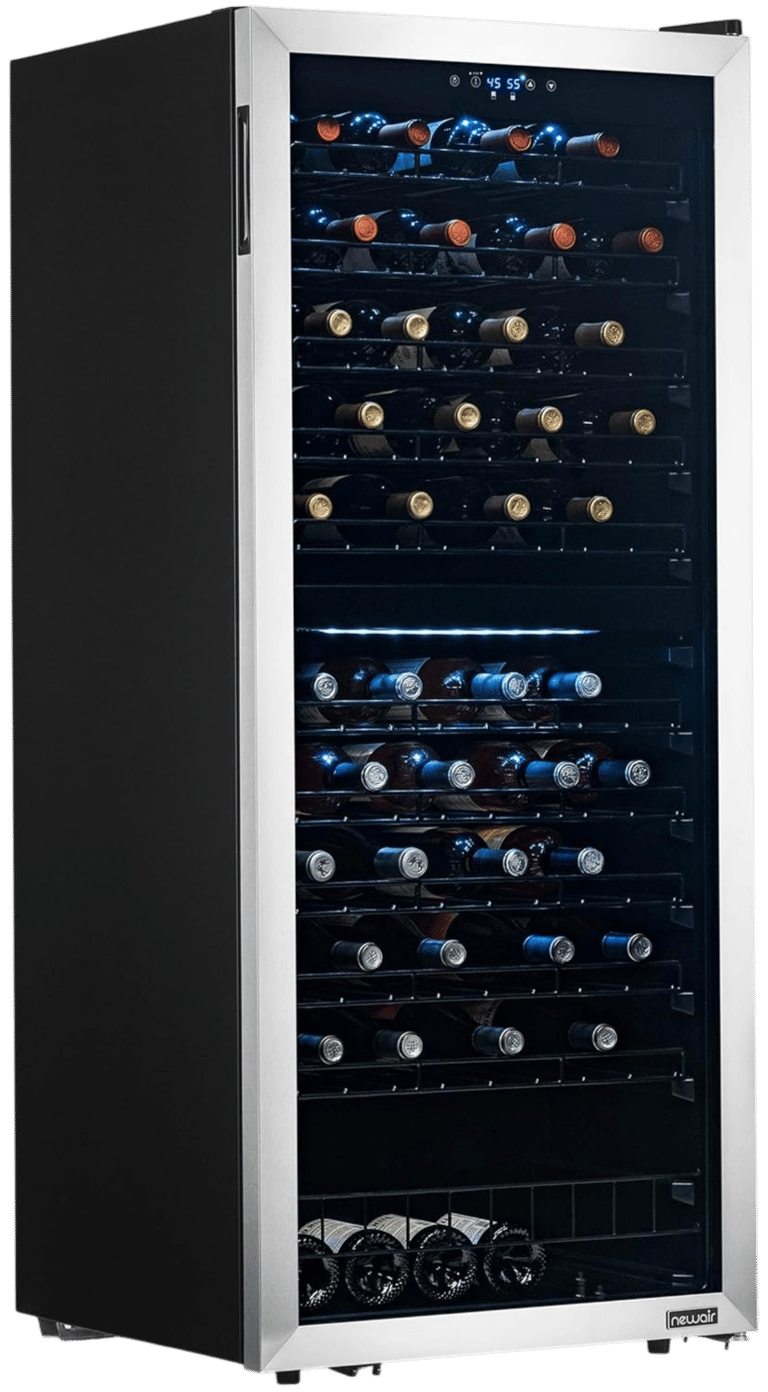
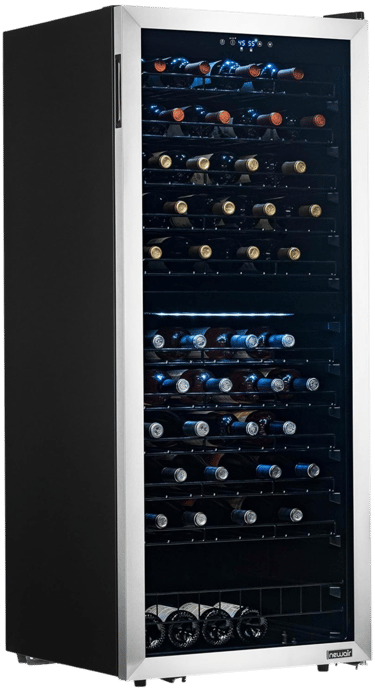
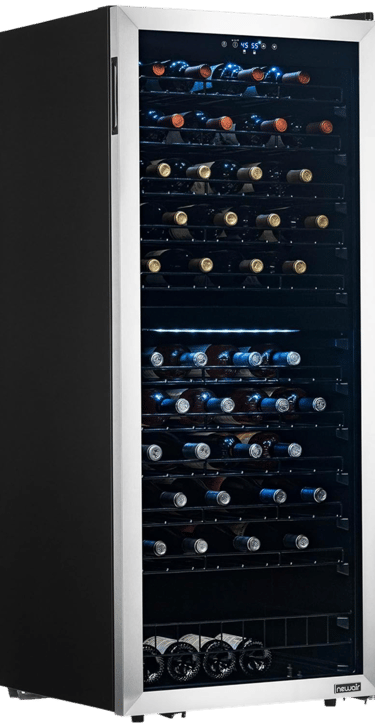
NewAir 24" Dual Zone Wine Fridge — 98 Bottles
The NewAir 98-Bottle Dual Zone moves directly into collector-level storage territory.
This is no longer a casual countertop or apartment wine fridge — it’s designed for people building larger long-term collections or integrating dedicated wine storage into a serious home bar system.
The biggest strength here is scale combined with organization.
The wider 24-inch design dramatically improves:
bottle access
shelf usability
larger bottle management
collection separation
entertaining flexibility
Unlike smaller compact coolers, this fridge feels much closer to a true cellar alternative.
The beech wood shelving and dual-zone layout also help the fridge feel more premium and collector-oriented than most standard appliance-style wine coolers.
Where this fridge performs best is scalability.
Specs (Quick Breakdown)
Capacity: 98 bottles
Model: NWC098SS00
Cooling Zones: Dual-zone independent cooling
Cooling System: Compressor cooling
Dimensions: 23.23” D × 23.43” W × 55.59” H
Weight: 165 lbs
Shelves: Slide-out beech wood shelves
Door: Stainless steel + glass door
Noise Level: Approx. 42 dB
Power Consumption: 160W
Configuration: Freestanding
Why This Wins
The NewAir is built for people whose collections are already outgrowing smaller dual-zone systems.
It delivers substantially more storage flexibility, better organization potential, and a much stronger long-term growth ceiling than compact wine fridges.
👉 If you’re building a serious home bar collection or dedicated wine storage setup, this is the strongest large-capacity option in this lineup.
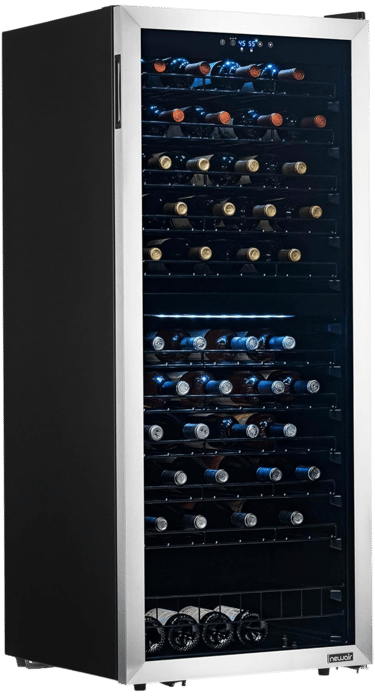
BUZZ'S TOP PICK
NewAir 24" Dual Zone
Best Large Collection
Ideal Temperature Ranges for Wine
Temperature precision directly affects taste.
Red Wine
55°F–65°F
White Wine
45°F–55°F
Sparkling Wine
40°F–50°F
Long-Term Storage
55°F stable baseline
If your bar serves both reds and whites regularly, a dual-zone wine fridge provides practical flexibility.
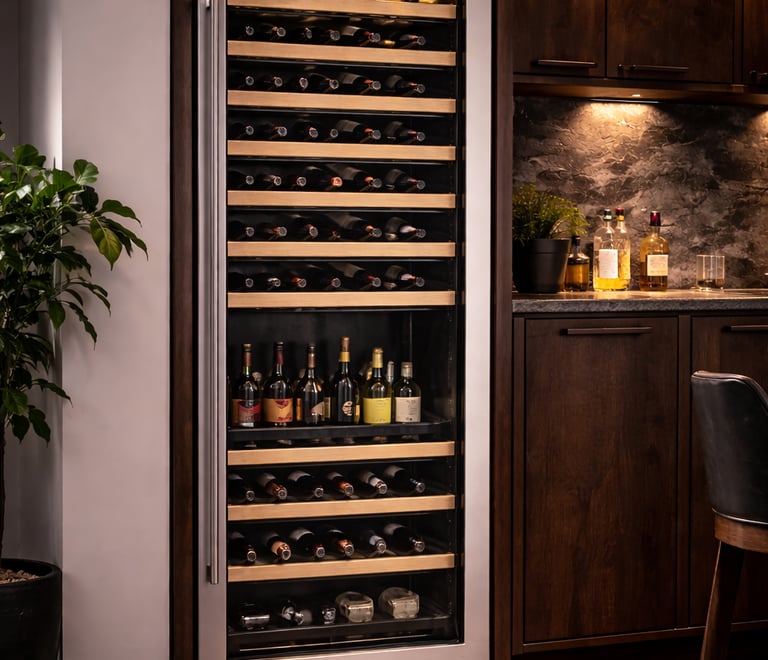
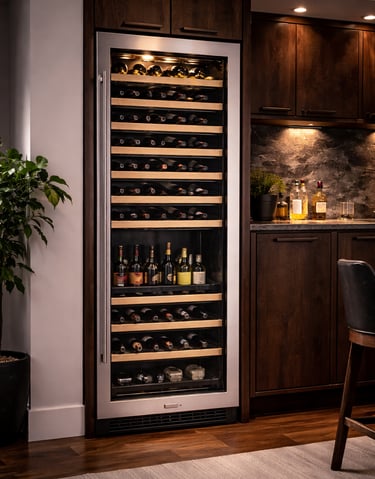
Key Evaluation Factors For Wine Fridges
Do not evaluate wine fridges on appearance alone.
Evaluate based on structural performance.
UV Protection
Look for:
Double-pane UV-resistant glass
Darkened tempered glass panels
Light exposure degrades wine over time.
Shelf Design
Adjustable shelves improve flexibility.
Look for:
Beechwood racks
Smooth slide-out functionality
Champagne bottle accommodation
Shelf structure affects storage efficiency.
Temperature Stability
Look for:
Digital thermostat control
Adjustable 40°F–65°F range
Low fluctuation tolerance
Stability matters more than coldness.
Ventilation Type
Rear Vent → Freestanding only
Front Vent → Built-in compatible
Incorrect installation reduces lifespan and efficiency.
Vibration Control
Long-term vibration affects aging.
Better units include:
Reinforced rack systems
Low-vibration compressors
Stabilized shelf tracks
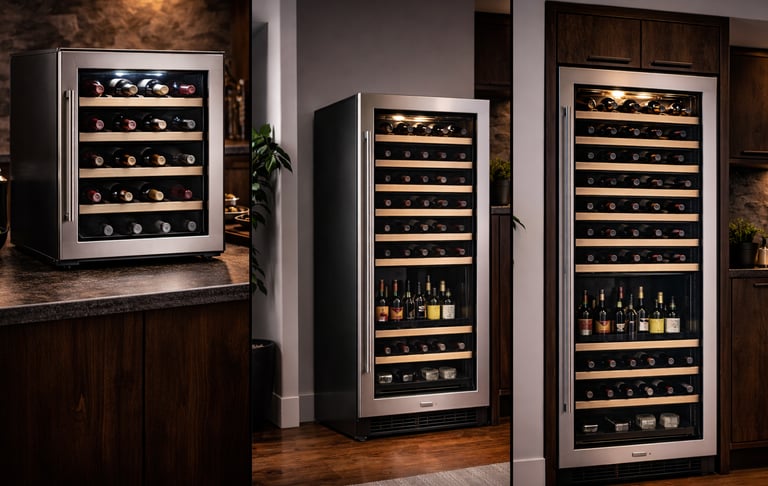
Size Recommendations by Home Bar Level
Casual Setup (6–18 Bottles)
12–24 bottle capacity
Compact freestanding
Short-term storage focus
Active Host (18–50 Bottles)
28–46 bottle capacity
Dual zone preferred
Balanced red & white rotation
Structured Wine Program (50+ Bottles)
46–100+ capacity
Built-in dual-zone
Long-term structured storage
Choose based on service needs — not aesthetics.
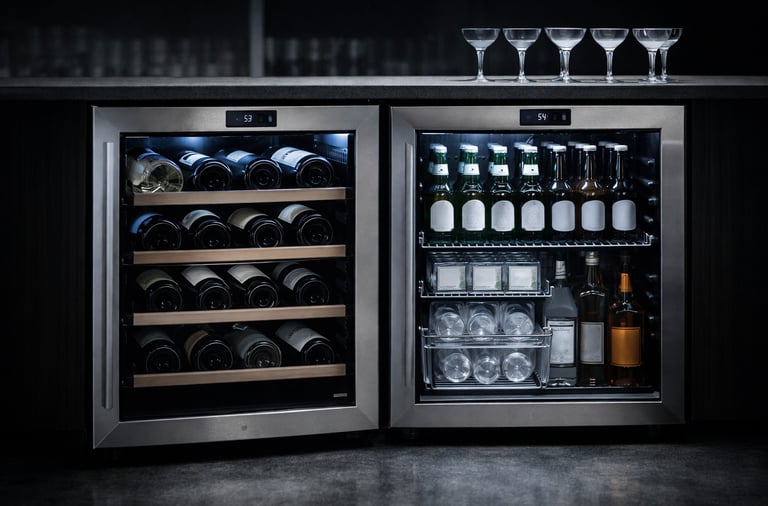
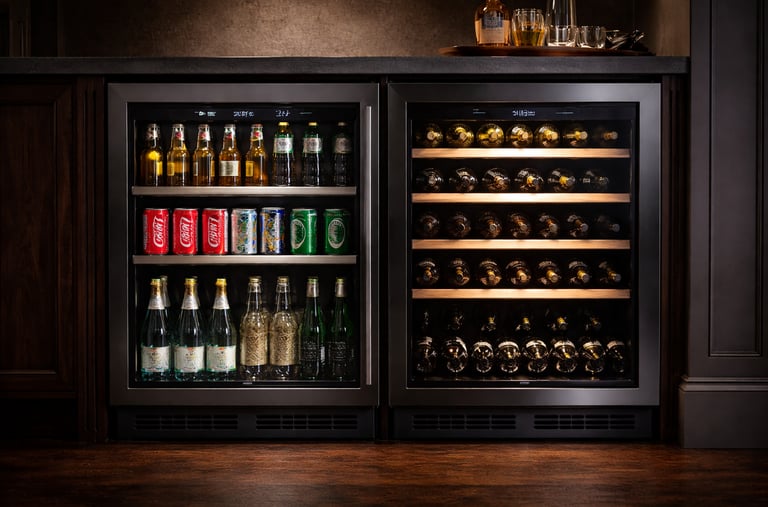
Wine Fridge vs Beverage Fridge
A beverage fridge:
Runs colder
Not humidity optimized
Designed for cans and mixers
Cycles more frequently
A wine fridge:
Maintains stable temperature range
Reduces vibration
Preserves bottle integrity
If wine is part of your regular bar service, separation improves longevity and flavor preservation.
Common Mistakes to Avoid
Installing freestanding units inside cabinetry
Overfilling racks
Setting temperature too low
Ignoring airflow requirements
Buying single-zone when dual-zone is needed
Planning prevents inefficiency.
Quick Picks for Your Home Bar
Wine Enthusiast
Dual Zone MAX
Balanced dual-zone cooling with strong everyday usability.


BUZZ PICK – Best Overall
Whynter 46 Dual Temperature Zone
Larger dual-zone storage with enthusiast-focused cooling.
BUZZ PICK – Best Enthusiast
Kalamera 18-Bottle 12" Wine Fridge
Slim built-in wine fridge for compact home bar layouts.
BUZZ PICK – Best Compact
NewAir 24" Dual Zone Wine Fridge
Large-capacity dual-zone storage for growing collections.
BUZZ PICK – Best Collection
Frequently asked questions
Do wine fridges keep wine colder than normal fridges?
No. Wine fridges are designed for stable preservation temperatures, not extreme cold. Kitchen refrigerators often run too cold for proper wine storage.
Is dual-zone necessary?
If you regularly store both red and white wine, dual-zone offers meaningful flexibility. If your collection is uniform, single-zone may suffice.
Can a wine fridge be installed under a counter?
Only if it is front-venting and rated for built-in installation. Rear-vent models require clearance.
How long can wine stay in a wine fridge?
For short-term storage, indefinitely. For aging, stability and bottle quality matter more than fridge duration.
Do wine fridges require maintenance?
Minimal. Periodic cleaning, ensuring proper airflow, and checking door seals are typically sufficient.
Are compressor models better than thermoelectric?
Compressor models generally offer better cooling stability and are more suitable for larger collections.
Can wine fridges store champagne?
Yes, if shelving accommodates larger bottles. Dual-zone units are ideal for sparkling storage.
What size wine fridge is best for a home bar?
For most home bars, 24–46 bottle capacity offers balance between flexibility and footprint.
Where Do You Want to Go Next?
Choose your path based on what you need right now.
You don’t need to build your home bar one piece at a time with no plan. A good setup starts with the layout, storage, appliances, lighting, and serving flow working together.
Start here if you want the full home bar framework before choosing more equipment.
Explore Everything
Before you buy more furniture or appliances, make sure the full setup makes sense. Placement, power, storage, refrigeration, lighting, and workflow all matter more than people expect.
Use this if you’re still mapping out the room before committing to gear.
Compare Before You Buy
If you don’t want to overthink it, don’t.
The Wine Enthusiast 32-Bottle Dual Zone MAX balances storage capacity, dual-zone flexibility, and real-world placement better than most home bar wine fridges.
Start with a wine fridge that performs consistently and fits naturally into the room.
Just Get It Done
© 2026 Barkeepers Buzz. All rights reserved.
Barkeepers Buzz
Master cocktails, spirits, and bar knowledge with clarity and precision. Built for serious home enthusiasts.
Crafted with respect for the culture — and the responsibility that comes with it.
For educational purposes only. Intended for legal drinking age audiences. Please drink responsibly.
General Inquiries: