
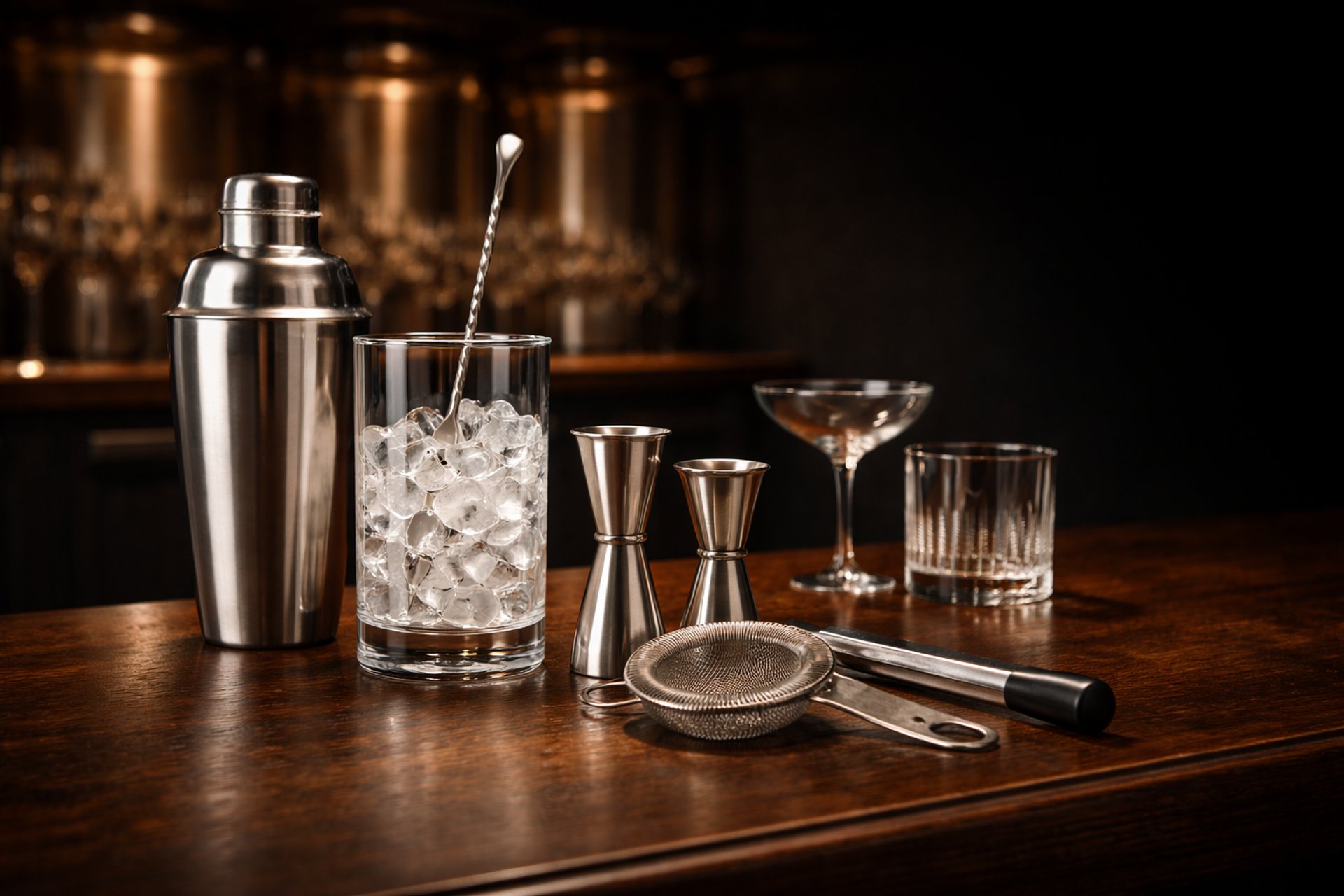
Best Mixing Glasses
Not every cocktail should be shaken.
Stirred drinks require controlled dilution without aeration. A proper mixing glass allows precise temperature management while preserving clarity and texture.
This guide evaluates:
Wall thickness
Base stability
Seam construction
Spout design
Capacity
Durability
No decorative etched vessels.
No thin novelty glassware.
Only functional tools designed for controlled stirring.
BEST OVERALL
Essential Mixing Glass
Best for: Most Home Bars
$$
BEST Refined
Refined Mixing Glass
Best for: Frequent Use
$$ - $$$
BEST PREMIUM
Pro Mixing Glass
Best for: Long-Term Build
$$$
Transparency Note: We may earn a commission from qualifying purchases. Product selections are made independently and are not influenced by manufacturers.
Why a Mixing Glass Matters
A dedicated mixing glass matters for stirred drinks:
Maintains clarity
Improves stirring efficiency
Controls dilution rate
Provides proper pouring angle
While some use a shaker tin for stirring, a well-built mixing glass offers greater precision and control.
Ideal for:
Manhattans
Negronis
Martinis
Boulevardiers
Old Fashioneds (stirred variation)
What to Look For
Prioritize:
Heavy, weighted base
Thick walls for insulation
Seamless interior construction
Defined pouring spout
Capacity of at least 16–20 oz
Avoid:
Thin decorative glass
Poorly attached spouts
Lightweight bases prone to tipping
Weight provides stability during stirring.
Seamless vs Patterned Glass
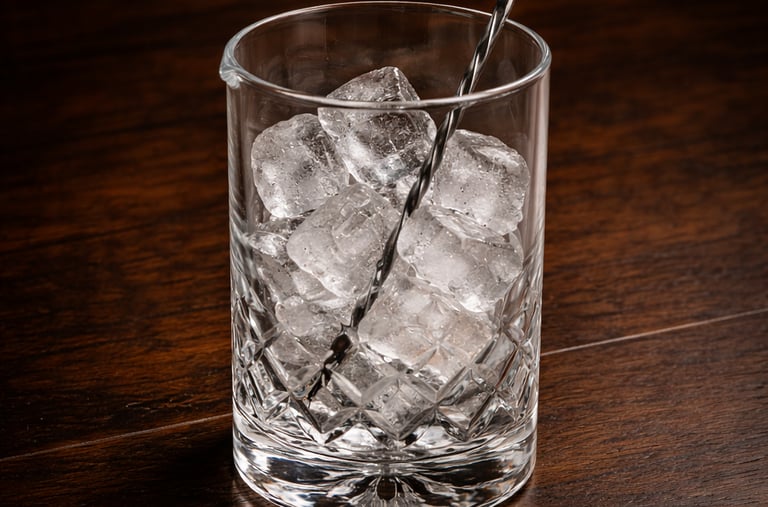
Seamless Mixing Glass:
Smooth interior
Cleaner aesthetic
Easier cleaning
Preferred for durability
Patterned Glass:
Textured exterior
Decorative appeal
Slightly reduced interior visibility
For functional use, seamless designs often perform better.
When building a home bar from scratch, durability and functionality matter far more than decorative glass patterns.
Capacity Considerations
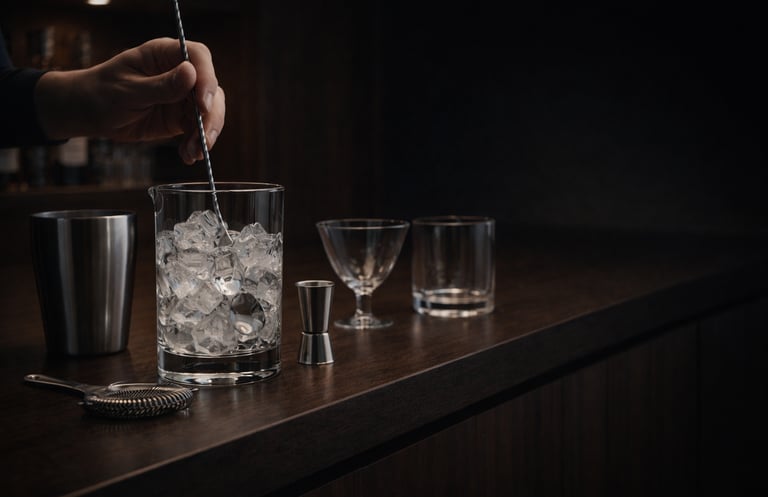
Choose a mixing glass that can:
Hold at least two cocktails comfortably
Accommodate adequate ice volume
Allow proper spoon circulation
Too small restricts dilution control.
Too large reduces stirring efficiency.
Most stirred drinks are built using precise measurements, so pairing your mixing glass with an accurate jigger improves repeatability.
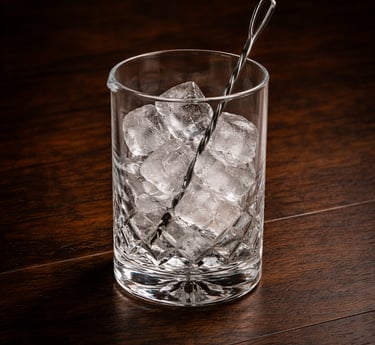
Choosing the Right Mixing Glass
Essential · Tempered Mixing Glass
The Essential tier prioritizes functional stability and reliable thermal retention.
It is ideal for building foundational stirring technique without unnecessary weight or ornament.
Tempered glass construction
Moderate wall thickness
Stable flat base
Clean V-style pour lip
500–650 ml capacity
Best suited for daily stirred cocktails and foundational home bar use.
Refined · Weighted Mixing Glass
The Refined tier improves thermal mass and base stability.
It is designed for repeated use while maintaining precise pour control and balanced handling.
Thicker wall construction
Weighted base for reduced movement
Precision-cut pour spout
Improved thermal retention
600–750 ml capacity
Recommended for frequent entertaining and consistency-focused home bars.
Service Grade · Professional Mixing Glass
The Service Grade tier emphasizes structural integrity under repetition.
Material thickness, base weight, and spout geometry are engineered for sustained performance in high-volume environments.
Heavy weighted base
High thermal mass
Sharp precision pour lip
Reinforced glass or crystal construction
Commercial durability standards
Built for extended stir sessions and professional service environments.
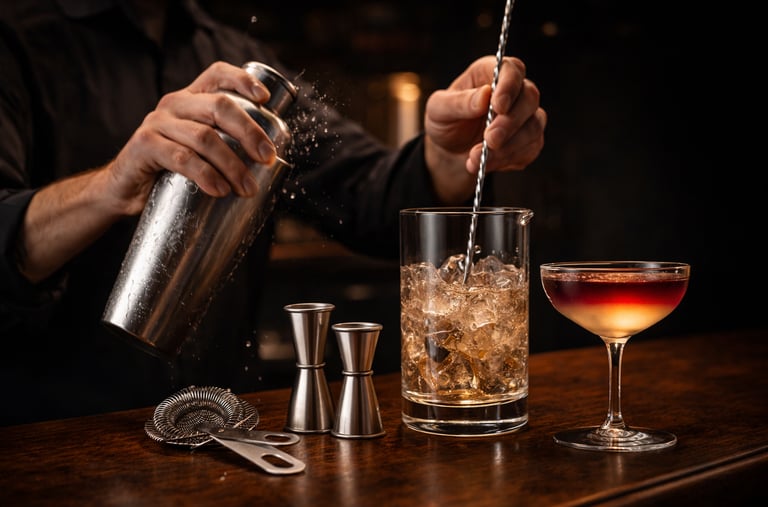
If you are building a complete stirring setup, a mixing glass is typically used alongside a bar spoon, jigger, and strainer.
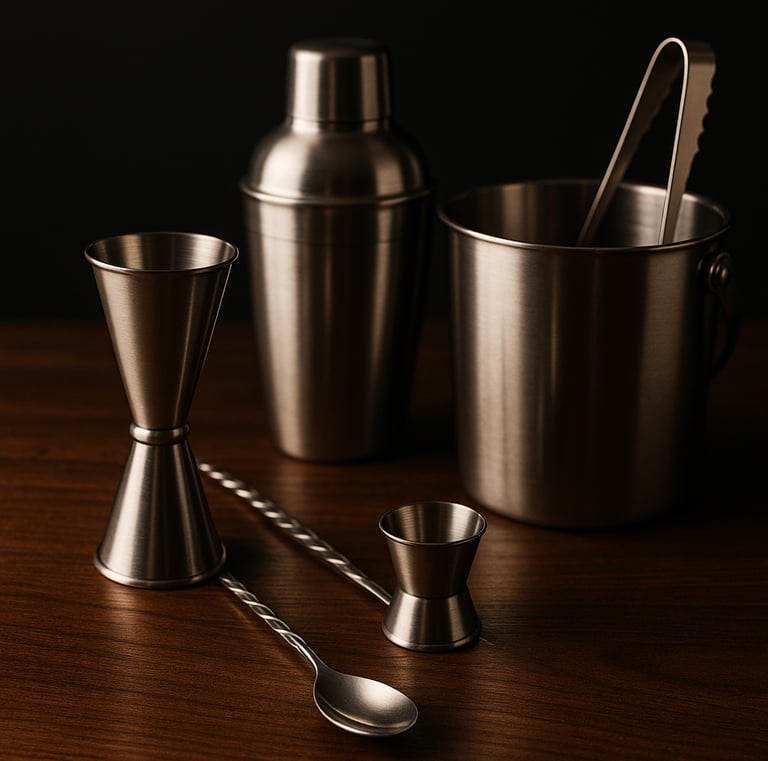
Stirred cocktails demand temperature control, structural stability, and clean transfer.
A mixing glass should be selected based on wall thickness, base weight, spout geometry, and durability — not decorative pattern.
Below is a clear breakdown of the structural tiers that matter most.
Essential Mixing Glass
24 Ounce
BEST FOR: EVERYDAY STIRRED COCKTAILS
Built for temperature control + controlled pours. The goal isn’t presentation — it’s wall thickness, base stability, and consistent dilution.
TYPE
Essential
POUR LIP
Standard V-Spout
STABILITY
Flat Base · Balanced
THERMAL MASS
Moderate
WHY IT WINS Essential
• Holds temperature for standard stir sessions
• Stable during active stirring
• Predictable pour with minimal drip
USE CASE
• Daily stirred cocktails
• Two-drink batching
• Home bar foundation
8.9
OVERALL SCORE
Refined Mixing Glass
24 Ounce
BEST FOR: REPEATED SERVICE
The goal isn’t weight alone — it’s improved wall thickness, cleaner pours, and greater stability under repetition.
TYPE
Refined
POUR LIP
Precision Cut
STABILITY
Weighted · Balanced
THERMAL MASS
High
WHY IT WINS Refined
• Retains chill longer
• Clean, narrow pour stream
• Reduced wobble during stir cycles
USE CASE
Back-to-back cocktail prep
Entertaining at volume
Consistency-focused home bar
9.2
OVERALL SCORE
Pro Mixing Glass
30 Ounce
BEST FOR: SERVICE ENVIRONMENTS
Built for thermal control. The goal isn’t decoration — it’s material integrity, spout geometry, and performance under repetition.
TYPE
Pro / Service
POUR LIP
Sharp Precision Spout
STABILITY
Heavy Weighted Base
THERMAL MASS
Commercial durability
WHY IT WINS Pro
Maintains low temperature
Exceptionally clean pour
Stable under fast service conditions
USE CASE
High-volume service
Advanced dilution control
Professional bar workflow
9.4
OVERALL SCORE
How We Evaluate Mixing Glasses
1. Wall Thickness & Thermal Mass
Wall thickness directly impacts temperature stability during stirring.
Greater thermal mass slows temperature rise, allowing controlled dilution over extended stir sessions. Thin walls fluctuate faster and reduce consistency across multiple builds.
We assess:
Glass thickness consistency
Chill retention during standard 20–30 second stir cycles
Temperature stability across repeated use
2. Base Stability
A mixing glass must remain stable under motion.
Base diameter, weight distribution, and flatness determine resistance to lateral movement during active stirring.
We assess:
Weighted vs unweighted base
Contact surface stability
Movement under moderate stirring pressure
3. Pour Spout Geometry
Transfer control matters.
A properly cut V-spout or precision lip produces a narrow, controlled stream and minimizes drip along the rim. Rounded or poorly cut lips create inconsistent flow and spill risk.
We assess:
Stream control
Drip resistance
Alignment with standard strainers
A mixing glass is a temperature control tool.
Its performance is determined by structural integrity, thermal mass, and pour geometry — not decorative pattern or brand prestige.
Our evaluations focus on function under repetition.
Our evaluation process follows the same structural criteria we apply across all professional bar tools.
4. Capacity & Ice Accommodation
A mixing glass must handle real ice load — not just volume measurement.
We test functional capacity with standard freezer cubes and large-format ice to evaluate space, movement, and choke points.
We assess:
2–3 drink batch comfort
Ice rotation clearance
Strainer seat fit
5. Material Integrity & Durability
Glass must withstand repeated temperature shifts and mechanical agitation.
We evaluate resistance to:
Stress fractures
Edge chipping
Spout degradation
Surface scratching over time
Lead-free crystal and tempered glass are assessed on structural performance, not clarity or aesthetic appeal.
What We Do Not Consider
Decorative cut patterns
Brand reputation
Packaging presentation
Social media appeal
A mixing glass is graded on repeatable performance — not visual impression.
Structure determines quality.
Frequently Asked Questions
What size mixing glass is ideal?
For most use cases, 600–750 ml provides sufficient capacity for 2–3 stirred cocktails with proper ice clearance.
Smaller glasses can restrict ice movement and increase dilution variability. Larger vessels are useful for batching but require greater control to maintain temperature consistency.
Capacity should match workflow — not aesthetics.
Does thicker glass actually improve performance?
Yes.
Greater wall thickness increases thermal mass, slowing temperature fluctuation during stirring. This allows more controlled dilution across repeated builds.
Thin-walled glass chills quickly but also warms faster, reducing consistency.
Is crystal better than tempered glass?
Not automatically.
Lead-free crystal can provide higher density and refined spout shaping. Tempered soda-lime glass offers durability and impact resistance.
Material choice matters less than structural integrity, wall thickness, and spout geometry.
Performance determines value — not material label.
Do decorative cut patterns improve grip?
Sometimes — but they are not inherently superior.
Deep-cut patterns can improve surface friction under condensation. Shallow decorative etching often provides no functional benefit.
Grip should be evaluated structurally, not stylistically.
What makes a pour spout “good”?
A properly cut V-spout produces:
Narrow stream control
Minimal drip
Clean alignment with standard strainers
Rounded or poorly defined lips increase spill risk and transfer inconsistency.
Spout geometry directly affects workflow efficiency.
Do I need a weighted base?
For frequent use — yes.
A weighted base reduces lateral movement during aggressive stirring and increases stability under repetition.
For occasional home use, a well-balanced flat base may be sufficient.
Stability matters more as volume increases.
Can a mixing glass replace a shaker?
No.
Mixing glasses are designed for stirred cocktails where clarity and controlled dilution are prioritized.
Shakers are designed for aeration and rapid chilling.
They serve different mechanical functions.
For cocktails that require shaking rather than stirring, a proper cocktail shaker is the correct tool.
How long should a quality mixing glass last?
A structurally sound mixing glass should withstand years of repeated use without:
Edge chipping
Spout warping
Structural stress fractures
Longevity depends on material integrity and handling — not brand.
How long should you stir in a mixing glass?
Typically 20–30 seconds, depending on:
Ice size and density
Starting liquid temperature
Desired dilution level
The mixing glass supports controlled dilution — it does not determine it.
Technique remains primary.
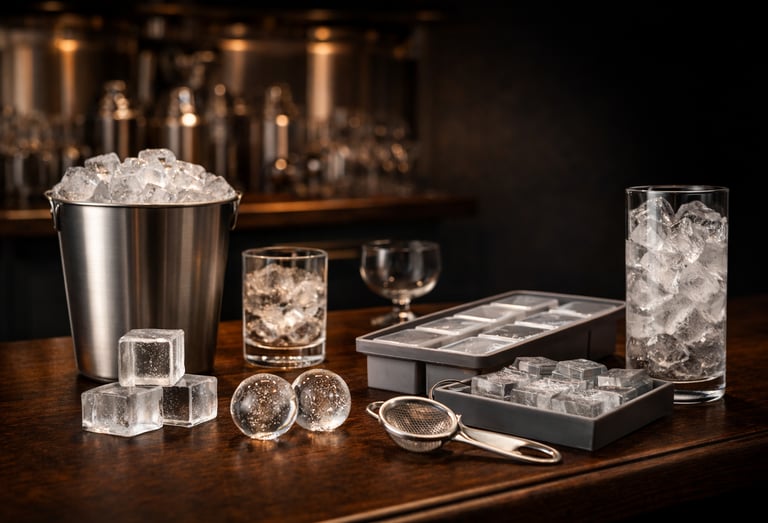
How does ice format interact with mixing glass performance?
Ice density and size directly influence thermal transfer.
Large-format clear cubes rotate differently than standard freezer ice. In smaller vessels, large cubes may restrict movement, reducing rotational efficiency and creating uneven chill zones.
A properly sized mixing glass should allow free ice movement without vertical stacking or choke points.
Glass structure supports ice mechanics — it does not override them.
Does mixing glass diameter affect dilution rate?
Yes.
Wider internal diameter allows greater ice displacement and surface contact, which can slightly increase dilution speed during aggressive stirring. Narrower vessels restrict ice rotation but may slow dilution marginally.
However, diameter must be evaluated alongside wall thickness and ice format. Dilution is a system variable — not a single measurement outcome.
Does pre-chilling the mixing glass materially improve results?
Yes — particularly in thinner-walled vessels.
Pre-chilling reduces initial temperature shock and stabilizes early dilution rates during the first 5–10 seconds of stirring.
In heavier, high-thermal-mass glasses, the effect is less pronounced but still beneficial in high-precision builds.
Pre-chilling improves consistency more than it improves speed.
Mixing Glass vs Shaker Tin for Stirring
While a shaker tin can technically stir a drink, a mixing glass offers:
Better temperature visibility
Controlled pour angle
Improved stability
Refined workflow
For serious enthusiasts, a mixing glass is foundational.
Understanding the difference between shaker systems can also help clarify when stirring or shaking is appropriate.
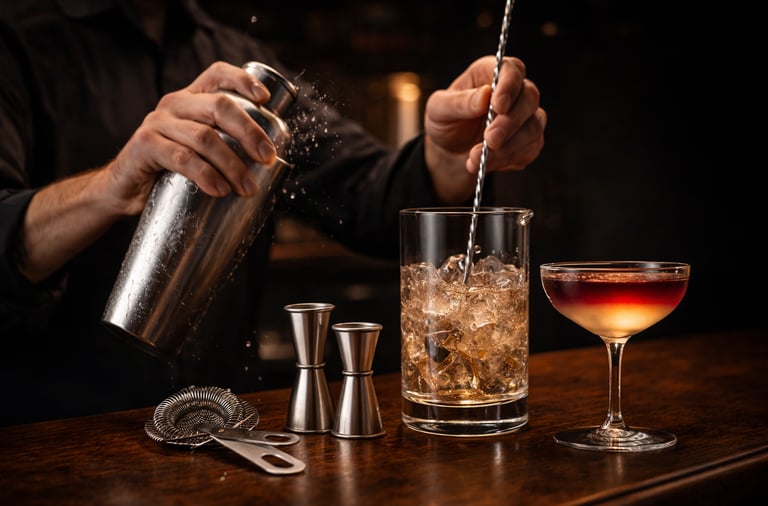

Building Intelligently
A refined home bar benefits from:
One dedicated mixing glass
One weighted Boston shaker
One accurate jigger
Proper ice
Together, these form a complete preparation system.
A refined home bar benefits from tools designed to work together.
Bar spoons control stirring speed and dilution.
Jiggers ensure precise measurements.
Strainers refine texture and clarity after mixing.
Together with a mixing glass, these tools create a complete preparation system.
If you're building your setup from scratch, start with the essential tools for a home bar before expanding your equipment.
© 2026 Barkeepers Buzz. All rights reserved.
Barkeepers Buzz
Master cocktails, spirits, and bar knowledge with clarity and precision. Built for serious home enthusiasts.
Crafted with respect for the culture — and the responsibility that comes with it.
For educational purposes only. Intended for legal drinking age audiences. Please drink responsibly.
General Inquiries: