
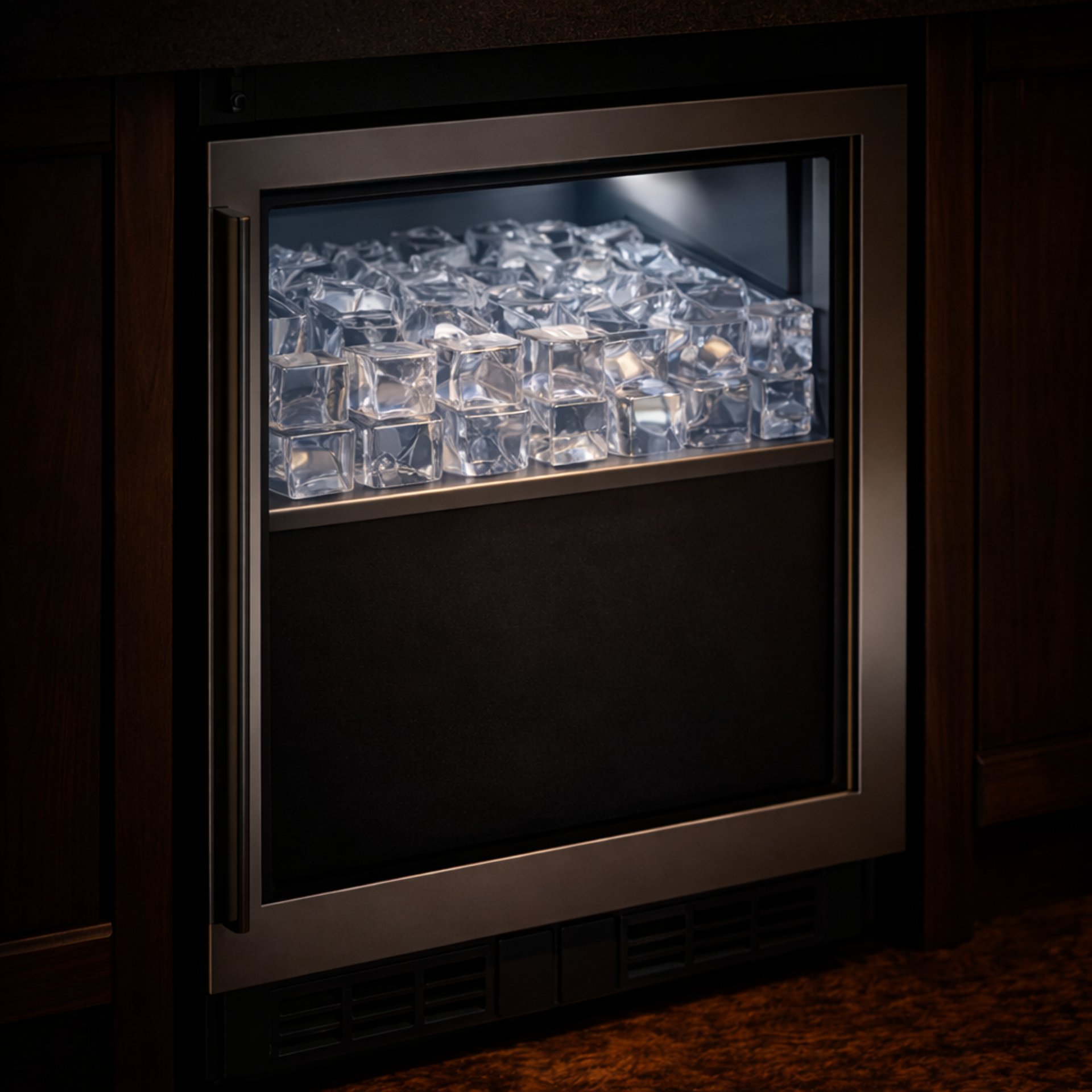
Automatic Clear Cube & Sphere Systems
Clear ice is not aesthetic refinement.
It is thermal control.
Large-format clear cubes and spheres are designed to regulate dilution rate, maintain temperature stability, and manage surface-area exposure during service.
Automatic systems remove the variability of manual freezing and produce consistent, structurally sound ice formats suitable for disciplined bar workflow.
This page evaluates countertop automatic systems that produce large-format clear cubes and spheres — not molds, not block carving, and not nugget ice.
Structure determines quality.
Transparency Note: We may earn a commission from qualifying purchases. Product selections are made independently and are not influenced by manufacturers.
Why Clear Ice Matters
Cloudy ice contains trapped air and impurities. These inconsistencies increase melt instability and accelerate dilution.
Clear ice:
Freezes directionally
Minimizes internal air pockets
Melts more predictably
Maintains structural integrity longer
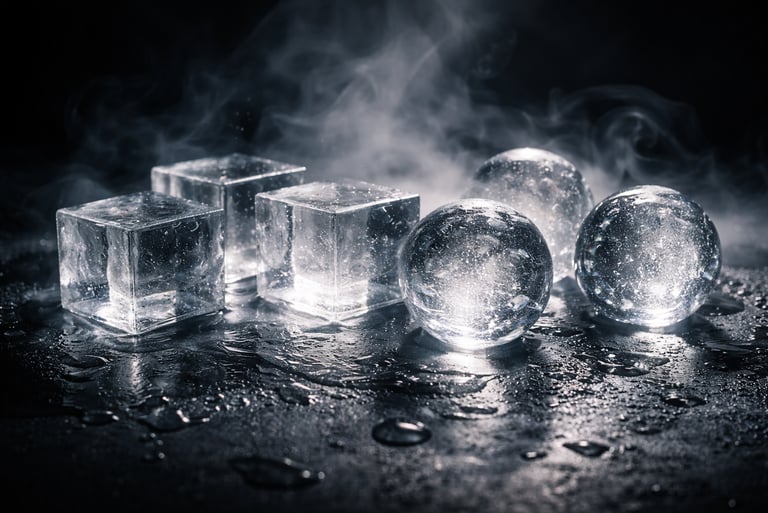
When scaled into large cubes or spheres, clear ice becomes a controlled thermal instrument.
For more info, Clear Ice vs Cloudy Ice: What Actually Changes in the Drink breaks down why structural clarity affects melt behavior, dilution pacing, and long-term drink stability.
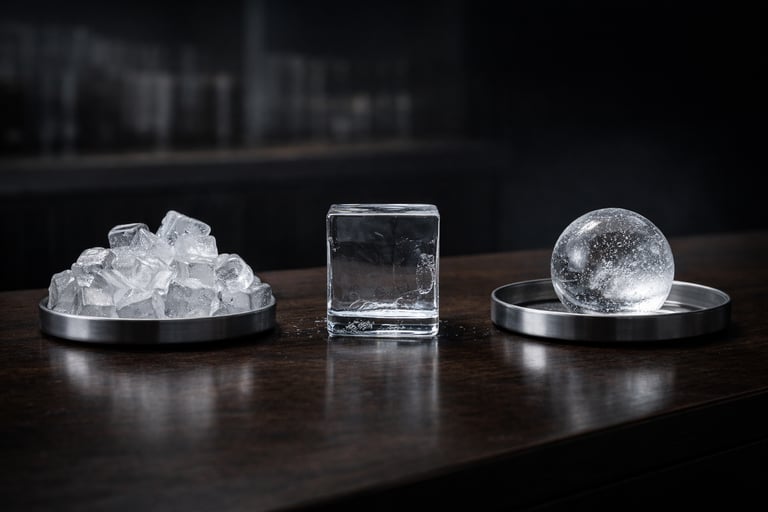
Cube vs Sphere: Structural Differences
Clear Cubes
Large cubes provide more balanced dilution pacing and structured chill control for cocktails like Old Fashioneds, Negronis, and whiskey-on-the-rocks pours.
Large cubes provide:
Balanced surface area
Stable dilution pacing
Controlled melt curve
Compatibility with rocks glasses
They are ideal for:
Old Fashioned
Negroni
Whiskey on the rocks
Spirit-forward builds
Cubes offer structured control without excessive concentration.
If your focus is controlled dilution instead of maximum chill speed, Best Countertop Clear-Style Ice Makers for Home Bars compares systems designed around cube consistency and daily usability.
Clear Spheres
Spheres reduce surface-area exposure and slow melt rate more aggressively than cubes, making them ideal for whiskey pours, sipping drinks, and longer-form service.
Spheres provide:
Minimal surface area relative to volume
Slowest melt rate
Maximum thermal mass
Extended chill duration
They are ideal for:
Neat whiskey
Minimal-dilution pours
Long-form sipping service
Spheres prioritize temperature stability over dilution speed.
For a deeper breakdown of thermal performance and drink pacing, How Ice Shape Controls Dilution Rate explains why sphere geometry behaves differently in the glass.
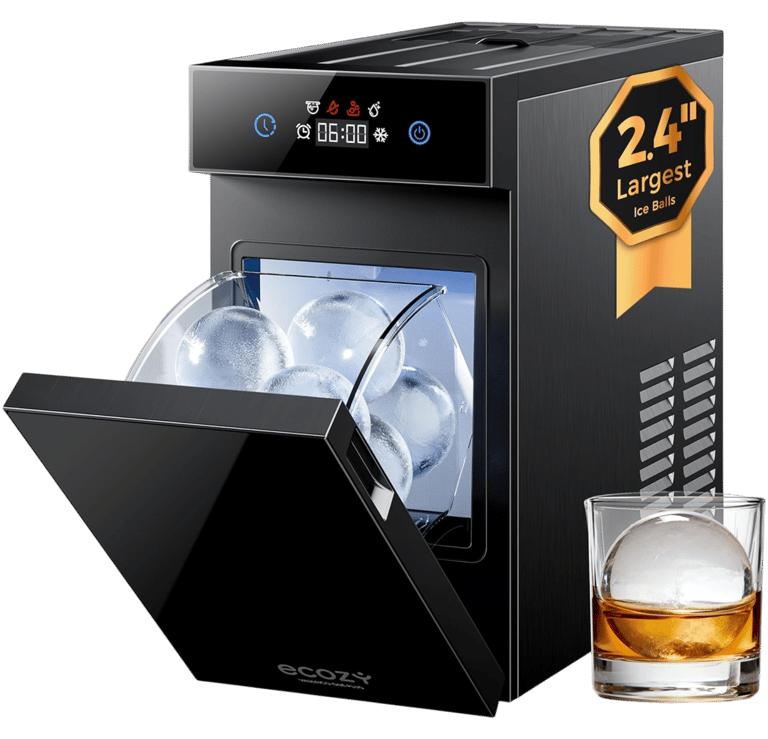
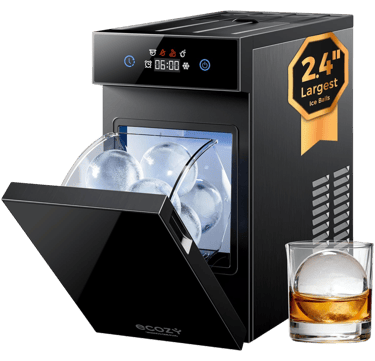
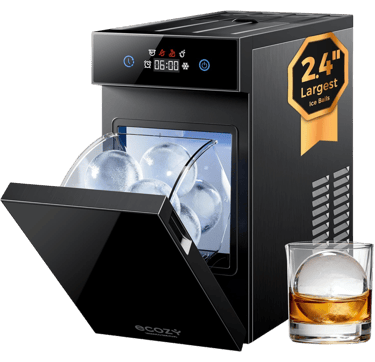
ecozy 2.4" Clear Ice Ball Maker
The ecozy 2.4" Clear Ice Ball Maker is one of the more ambitious countertop sphere systems currently available because it focuses on directional freezing, clarity control, and larger-format whiskey ice instead of traditional cube production.
Unlike standard countertop ice makers that prioritize speed, the ecozy is designed around slow crystal-clear sphere formation using its “CrystalFlux” freezing system. The result is noticeably clearer and denser ice spheres that melt slower and perform better in spirit-forward drinks.
This is one of the better fits if presentation, whiskey service, and slow dilution matter more than raw ice volume.
Best For
Whiskey pours
Old Fashioneds
Cocktail presentation
Slow dilution setups
Home bars focused on craft drinks
Specs (Quick Breakdown)
Ice Type: 2.4" clear ice spheres
Sphere Production: 4 spheres per cycle
Cycle Time: Around 8 hours
Freezing System: Directional freezing / CrystalFlux technology
Water Reservoir: Integrated refill system
Controls: Touch control panel
Connectivity: App-enabled on listing
Cleaning: Self-cleaning mode
Design: Countertop sphere ice system
Primary Use: Slow-melting whiskey ice
Why This Wins
The ecozy wins because it behaves more like a dedicated craft ice appliance than a standard countertop ice maker. It prioritizes clarity, sphere size, and slow dilution performance over convenience production.
👉 This is the better choice if your focus is whiskey presentation and slower melt behavior instead of high-volume entertaining.
If you are comparing precision sphere systems against hybrid countertop machines, Klaris Mini vs EUHOMY 2.4" Sphere breaks down how sphere size, clarity control, and workflow differ between systems.
BUZZ'S TOP PICK
ecozy 2.4" Clear Ice Ball Maker
Best Overall
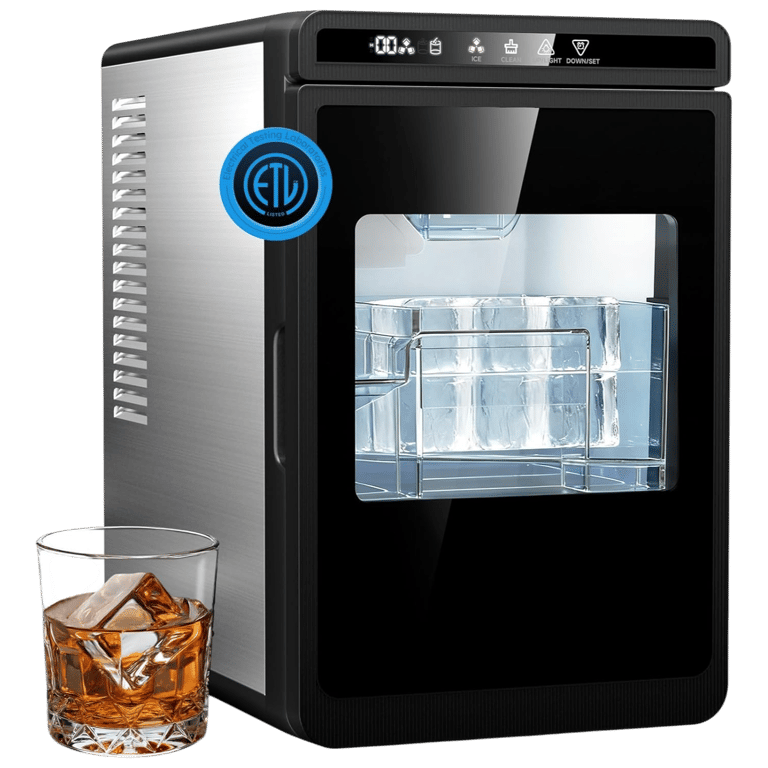
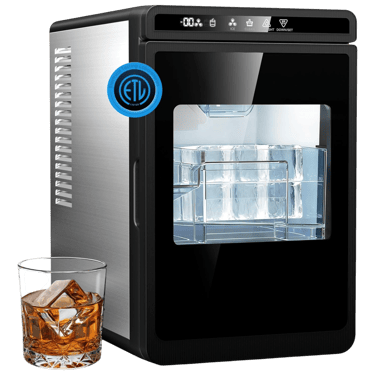
Mojgar 1.6" Clear Ice Square Maker
The Mojgar 1.6" Clear Ice Square Maker focuses on compact countertop clear ice production for cocktails, whiskey, and mixed drinks without taking up the footprint of larger directional freezing systems.
Its smaller 1.6-inch format makes it more practical for general cocktail use than oversized whiskey spheres, especially if you want clearer ice that still fits standard glassware comfortably.
Compared to larger specialty systems, this machine leans more toward usability and convenience while still improving clarity and melt behavior over standard freezer ice.
Best For
Everyday cocktails
Compact home bars
Mixed drinks
Smaller whiskey pours
Casual entertaining
Specs (Quick Breakdown)
Ice Type: 1.6" clear square cubes
Cube Production: Multi-cube cycle system
Design: Compact countertop format
Controls: Digital control panel
Water System: Internal reservoir
Cleaning: Self-cleaning listed
Intended Use: Whiskey, cocktails, mixed drinks
Build Style: Portable countertop unit
Specialty Focus: Clear cocktail ice
Why This Wins
The Mojgar wins because it fills the middle ground between basic freezer molds and large-format specialty ice systems. It improves clarity and presentation without becoming a huge dedicated appliance.
👉 This is the practical option for users who want cleaner-looking cocktail ice without fully committing to oversized sphere systems.
For users trying to understand why directional freezing matters for clarity and melt consistency, Directional Freezing Explained (Without the Fluff) breaks down the actual freezing process behind clearer cocktail ice.
BUZZ'S TOP PICK
Mojgar 1.6" Clear Ice Square Maker
Best Compact Clear Cube
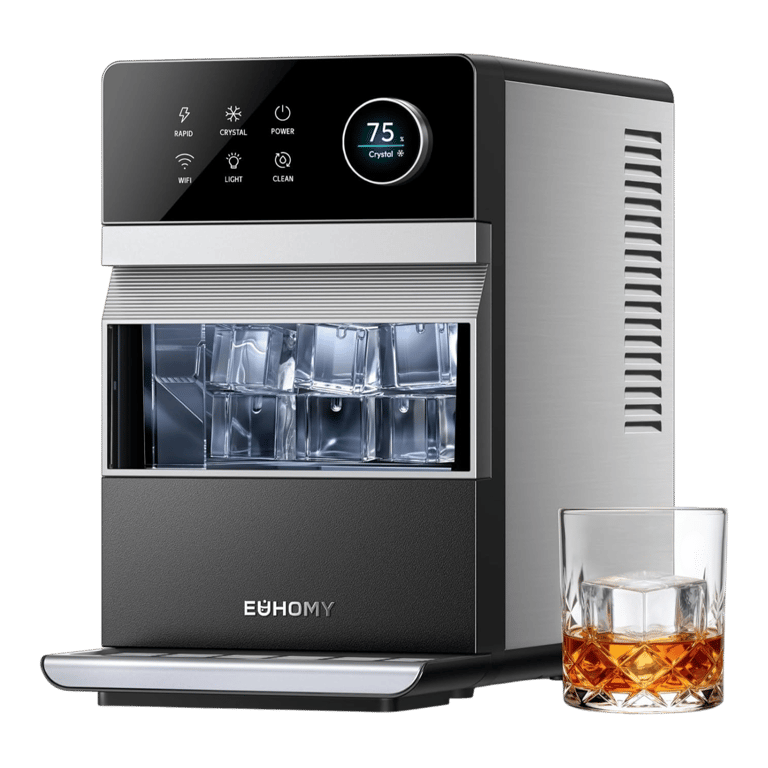
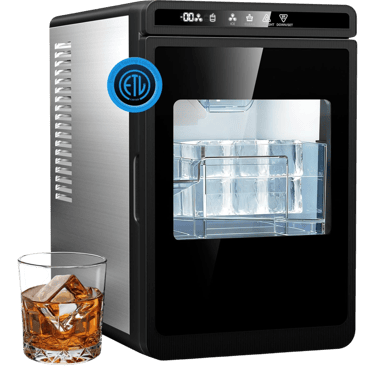
EUHOMY 2" Clear Ice Cube Maker Countertop with APP
The EUHOMY 2" Clear Ice Cube Maker is built around larger-format clear whiskey cubes while adding app connectivity, self-cleaning support, and countertop usability.
Instead of focusing on nugget or standard cube production, this machine prioritizes slower-melting 2-inch craft cubes designed for whiskey pours, cocktails, and presentation-focused drinks. The larger cube format improves dilution control while the app integration makes scheduling and monitoring easier than manual directional-freezing setups.
It is one of the more modern “smart craft ice” systems currently available.
Best For
Whiskey enthusiasts
Presentation cocktails
Smart home bar setups
Slow dilution drinks
Daily craft ice use
Specs (Quick Breakdown)
Ice Type: 2" clear craft cubes
Cube Size: Large-format whiskey cubes
Controls: App + touchscreen controls
Connectivity: Smart app support
Cleaning: Self-cleaning system
Production Style: Countertop clear ice production
Intended Use: Whiskey, bourbon, cocktails
Water System: Internal reservoir
Specialty Focus: Slow-melting clear cocktail cubes
Why This Wins
The EUHOMY wins by combining large-format craft ice with modern smart controls. It gives users cleaner whiskey cubes without relying entirely on freezer molds or manual directional freezing methods.
👉 This is the better choice if you want slow-melting cocktail cubes with easier day-to-day usability and smart scheduling support.
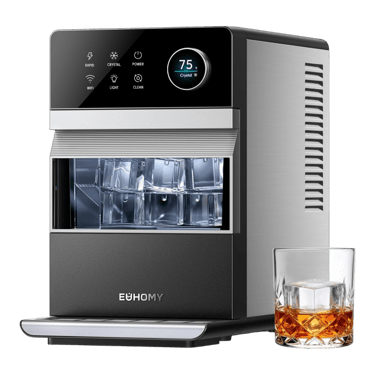
BUZZ'S TOP PICK
EUHOMY 2" Clear Cube Maker
Best Smart System
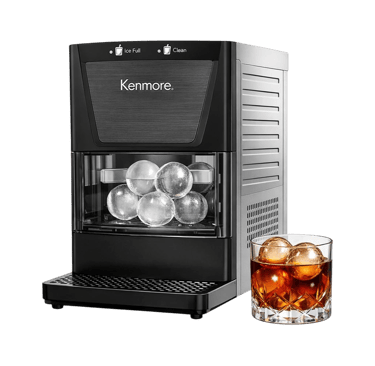
Kenmore Clear Sphere Ice Ball Maker
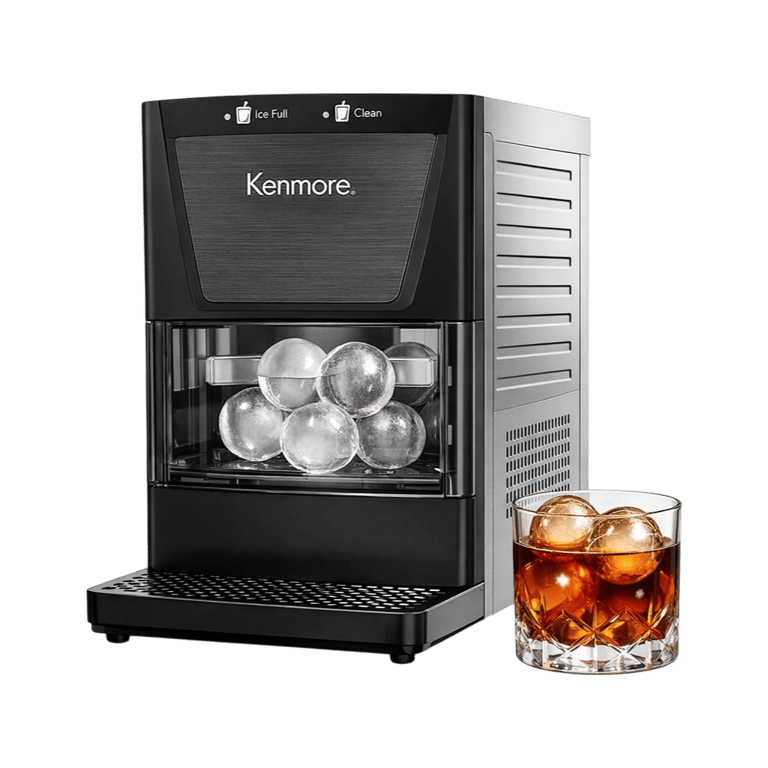
BUZZ'S TOP PICK
Kenmore Clear Sphere Maker
Best Everyday Sphere
The Kenmore Clear Sphere Ice Ball Maker is built for users who want larger whiskey ice spheres without dealing with traditional freezer molds or manual freezing systems.
It focuses on producing slow-melting clear ice spheres for bourbon, whiskey, cocktails, and presentation drinks while keeping the process simple enough for regular countertop use. Compared to more technical directional-freezing systems, the Kenmore leans more toward convenience and repeatable sphere production.
This makes it a strong middle-ground option between casual ice molds and more expensive craft ice appliances.
Best For
Everyday whiskey pours
Bourbon service
Slow dilution cocktails
Easy sphere ice production
Casual home bars
Specs (Quick Breakdown)
Ice Type: Clear ice spheres
Sphere Style: Large-format whiskey spheres
Design: Countertop craft ice maker
Intended Use: Whiskey and cocktail presentation
Controls: Simple digital controls
Cleaning: Self-cleaning support listed
Water System: Internal reservoir
Specialty Focus: Slow-melting cocktail spheres
Build Style: Compact countertop format
Why This Wins
The Kenmore wins because it simplifies sphere ice production without requiring freezer molds or complicated directional freezing prep. It balances usability and presentation better than most entry-level sphere systems.
👉 This is the easiest recommendation for people who want better whiskey ice without turning craft ice into a full hobby.
If your focus is whiskey presentation and slower dilution pacing, Best Whiskey Glasses for Large Ice Cubes (What to Look For) explains how glass shape and thermal exposure affect melt behavior during sipping pours.
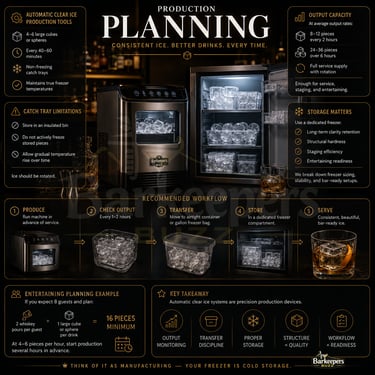
Production Planning
Automatic clear cube and sphere systems are production tools — not long-term storage units.
Most consumer-grade systems produce approximately:
4–6 large cubes or spheres
Every 40–60 minutes
With non-freezing catch trays
This means the ice bin holds finished pieces temporarily, but it does not maintain true freezer temperatures. Ice will begin to soften or fuse if left unattended for extended periods.
Production planning matters.
Understanding Output Capacity
At average output rates, you can expect:
8–12 pieces every 2 hours
24–36 pieces over a 6-hour period
Full service supply only with active rotation
For casual use, this is sufficient.
For entertaining, it requires staging.
Automatic systems are designed to produce consistently — not to stockpile indefinitely.
The Catch Tray Limitation
Most countertop units:
Store ice in an insulated bin
Do not actively freeze stored pieces
Allow gradual temperature rise over time
This is not a flaw.
It is a design constraint.
If ice is left in the catch tray for extended periods, structural clarity may remain intact — but surface softening and fusion can occur.
Ice should be rotated.
Recommended Workflow
Based on real-world usage patterns:
Run the machine in advance of service.
Check output every 1–2 hours.
Transfer finished cubes or spheres into:
Airtight container
Or gallon freezer bag
Store in a dedicated freezer compartment.
This creates a production buffer and prevents fusion or surface degradation.
Think of the machine as a manufacturing unit — and your freezer as cold storage.
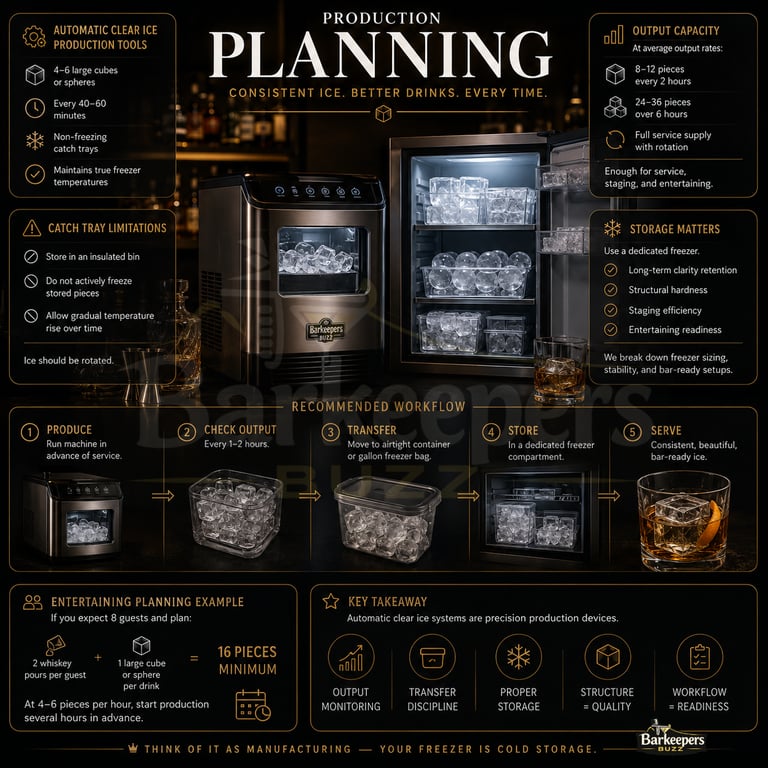
Entertaining Planning Example
If you expect 8 guests and plan:
2 whiskey pours per guest
1 large cube or sphere per drink
You’ll need 16 pieces minimum.
At 4–6 pieces per hour, production must begin several hours in advance — or the day prior with freezer staging.
Clear ice requires timing discipline.
Key Takeaway
Automatic clear ice systems are precision production devices.
They require:
Output monitoring
Transfer discipline
Proper freezer storage
Without planning, even the best machine will underperform during service.
Structure determines quality — but workflow determines readiness.
Storage Matters: Use a Dedicated Freezer
For consistent structural integrity, large-format clear ice should be stored in a true freezer environment.
If you regularly produce clear cubes or spheres, a dedicated bar freezer improves:
Long-term clarity retention
Structural hardness
Production staging efficiency
Entertaining readiness
We break down freezer sizing, temperature stability, and bar-ready storage configurations here: Best Home Bar Freezers

Choosing the Right Automatic Clear Ice System
Essential · Clear Cube Systems
Designed for balanced dilution control and daily rocks service.
These systems:
Produce consistent large-format cubes
Maintain directional freezing clarity
Offer moderate production capacity
Support foundational home bar workflow
Best suited for structured whiskey service and spirit-forward cocktails.
Professional · Precision Sphere Systems
Designed for maximum thermal mass and sustained service performance.
These systems:
Produce large-format spheres with structural uniformity
Maintain high freeze-cycle consistency
Deliver slow, predictable melt curves
Support high-discipline whiskey programs
Built for extended sipping environments and premium presentation standards.
Automatic Clear Ice Frequently Asked Questions
1. Is clear ice actually slower to melt?
Yes — when formed in large, dense formats.
Reduced air pockets and increased mass slow structural breakdown and regulate dilution pacing.
2. Are spheres better than cubes?
Not universally.
Spheres melt more slowly due to lower surface area. Cubes provide more balanced dilution in spirit-forward cocktails.
Use case determines format.
3. Do automatic systems produce truly clear ice?
Higher-quality systems using directional freezing or controlled freeze cycles can produce high-clarity output.
Consistency varies by engineering quality.
4. Is large-format ice necessary for whiskey?
Not mandatory — but structurally superior for controlled dilution and temperature stability.
5. Are countertop systems reliable long-term?
Reliability depends on mechanical design, water quality, and maintenance discipline.
Systems should maintain clarity consistency across repeated cycles.
6. Do spheres last significantly longer than cubes?
Yes.
Their reduced surface-area-to-volume ratio slows melt rate compared to cubes of similar volume.
7. Does water quality affect clarity?
Yes.
Mineral content and impurities influence internal clouding and freeze consistency.
Filtered water improves structural clarity.
8. Can automatic systems replace molds?
Yes — for consistency and workflow speed.
Molds require manual freezing cycles and offer less repeatable results.
9. Is nugget ice a substitute for clear cubes?
No.
Nugget ice is designed for agitation and rapid chill, not slow dilution or structural longevity.
They serve different thermal functions.
10. How long should a quality system last?
A well-built automatic clear ice system should maintain structural output and freeze reliability through sustained use without clarity degradation.
Durability supports disciplined bar workflow.
Quick Picks for Your Home Bar
ecozy 2.4" Clear
Ice Ball Maker
Crystal-clear spheres built for whiskey presentation


BUZZ PICK – Best Overall
Mojgar 1.6" Clear
Ice Square Maker
Compact clear ice system for slower dilution
BUZZ PICK – Best Precision
EUHOMY 2" Clear
Ice Cube Maker
Smart clear cube system with app-based controls
BUZZ PICK – Best Premium
Kenmore Clear
Sphere Ice Ball Maker
Large whiskey ice spheres with simple operation
BUZZ PICK – Best Crystal

Final Verdict
Automatic clear ice systems are not built for speed — they are built for structure, melt control, and repeatable drink performance.
Large-format cubes and spheres change how cocktails behave in the glass. They slow dilution, stabilize temperature longer, and create more consistent whiskey and spirit-forward pours compared to standard freezer ice or nugget systems.
If your priority is balanced cocktail control and versatile daily use, Best Countertop Clear-Style Ice Makers for Home Bars helps compare systems focused on practical bar workflows.
If your focus is premium whiskey presentation and slower melt behavior, Best Sphere Ice for Whiskey & Cocktails breaks down why sphere size and thermal mass matter for sipping drinks.
For a broader understanding of how different ice formats actually perform in real drinks, Ranking Ice Types (For Quality) explains where cubes, spheres, nugget ice, and clear ice systems fit in real-world bar use.
And if you're planning a complete setup instead of just a standalone machine, How to Choose an Ice Maker for Your Home Bar connects production style, storage planning, dilution goals, and entertaining workflow into one system.
At the end of the day, the best automatic clear ice machine is not the one with the most features.
It’s the one that matches how you actually drink, serve, and entertain.

Where Do You Want to Go Next?
Choose your path based on what you need right now.
You don’t need a complicated ice setup to improve your drinks. Better cubes, slower dilution, and proper chilling solve most home bar problems without overcomplicating your workflow.
Start with the fundamentals, then build around how you actually drink and entertain.
Explore Everything
Not all clear ice machines solve the same problem. Some focus on speed and output, while others prioritize clarity, presentation, or slower dilution for whiskey and cocktail use.
Comparing them side-by-side makes it easier to choose the right fit for your setup and drinking style.
Compare Before You Buy
If you want reliable Clear Ice Spheres without overthinking the process, start with the ecozy 2.4" Clear Ice Ball Maker. It produces large slow-melting spheres with cleaner clarity, consistent sizing, and simpler day-to-day operation for whiskey and cocktail setups.
Just Get It Done
© 2026 Barkeepers Buzz. All rights reserved.
Barkeepers Buzz
Master cocktails, spirits, and bar knowledge with clarity and precision. Built for serious home enthusiasts.
Crafted with respect for the culture — and the responsibility that comes with it.
For educational purposes only. Intended for legal drinking age audiences. Please drink responsibly.
General Inquiries: